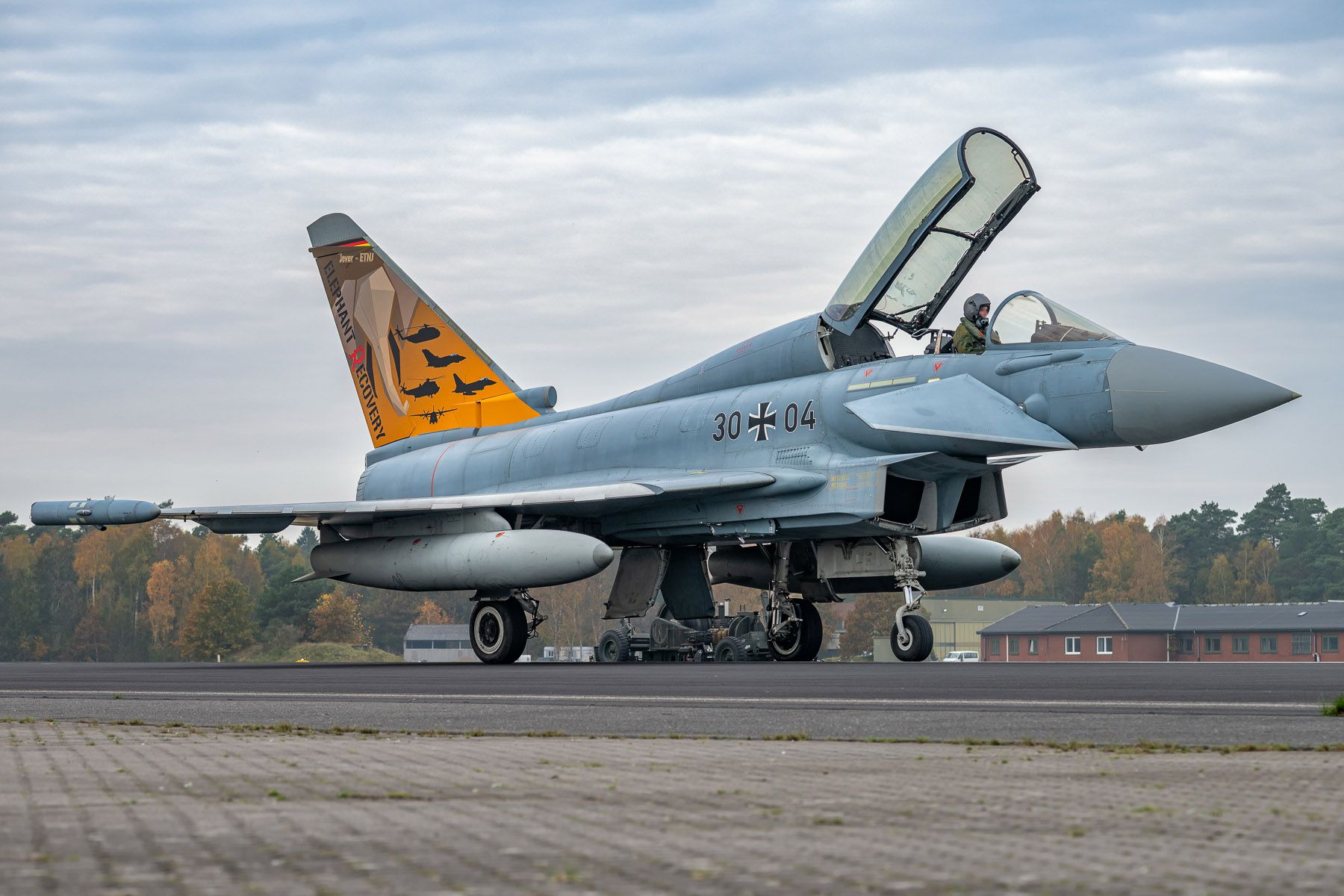
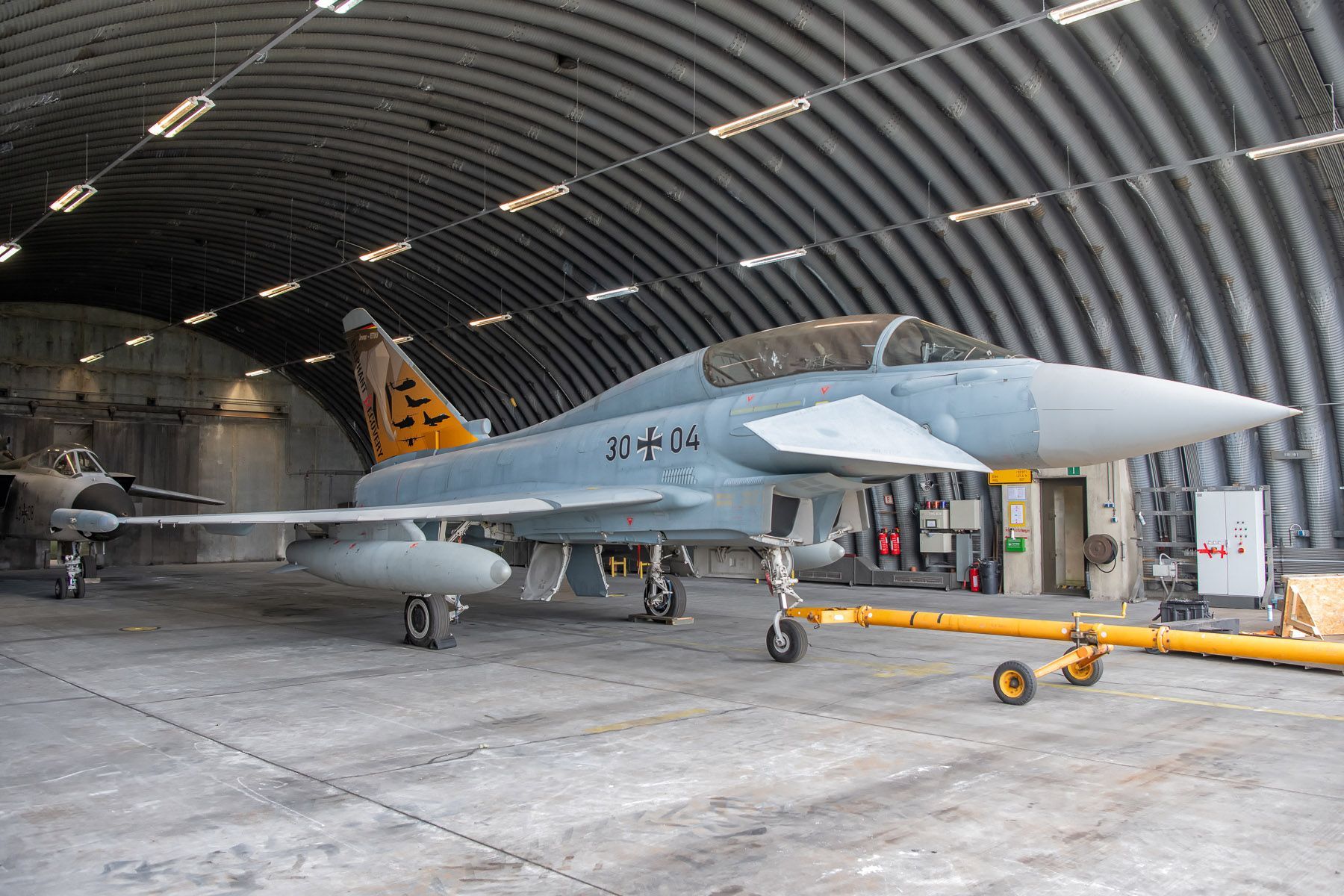
In September 2018, a dual-seat Eurofighter serialled 30+04 was taken to the air by the German Air Force for the last time. But did this event mark the beginning of a comfortable retirement in a warm hangar? No way. A useful destination was found for this airframe.
Text and photos: Emiel Sloot
Published 18 November 2026
Flying for various units
After Eurofighter GT0004 was assembled at EADS (now Airbus) at Manching in Bavaria, it made its first flight on 22 August 2003 and was subsequently handed over to the Luftwaffe on 8 October that same year. Initially it remained at Manching, together with other early models for the training of the first group of flight instructors. Pending the full certification for the Tranche 1 production aircraft, it temporarily carried serial 98+34. On 30 April 2004 it moved to Laage for service with Jagdgeschwader 73 “Steinhoff” where allocated serial 30+04 was applied in July 2004, when the mentioned type approval was issued.
After it had undergone the so-called R2 update programme at Manching bringing the aircraft to Block 5 standard, it was sent to Jagdbombergeschwader 31 “Boelcke” at Nörvenich on 27 March 2012. JaBoG 31 was renamed Taktisches Luftwaffengeschwader 31 on 1 October 2013.
When the Taktische Luftwaffengruppe “Richthofen” was established at Wittmund as part of TaktLwG 31, 30+04 did a stint over there. Following its next 400-hour overhaul at Manching, it went to the Taktisches Luftwaffengeschwader 71 – that now had become a full independent wing – on 30 May 2017. As the other way around, it was temporarily loaned to TaktLwG 31, until the Richthofen Geschwader operated the aircraft for the last time on 18 September 2018. This concluded a fifteen-year period of extensive airborne use with three different flying units.
The road ahead
Ends are often the starting points of new beginnings. Although 30+04 would never fly again, a new destination was eventually found. Following a few years of storage, the aircraft was prepared at Wittmund for transportation by road to a new destination: nearby Jever, a former active Luftwaffe air base. Active regarding flying activities that is, as Jever is the home location of the Objektschutzregiment der Luftwaffe “Friesland”. This unit has a very important support role. The main purpose is to create and protect an air base abroad, to make it suitable for prolonged safe and secure operations for the German Bundeswehr when needed.
After many valuable parts were harvested for future use including engines and ejection seats, the airframe was ready for transportation. The vertical fin was removed but the wings were still attached. Late evening 6 October 2022, roads between Wittmund and Jever were closed and the move commenced. Although several traffic signs had to be removed temporarily while some traffic light poles proved to be a challenge to circumnavigate, the process went fairly smoothly and after some four hours, 30+04 had arrived at Jever air base.
A new role
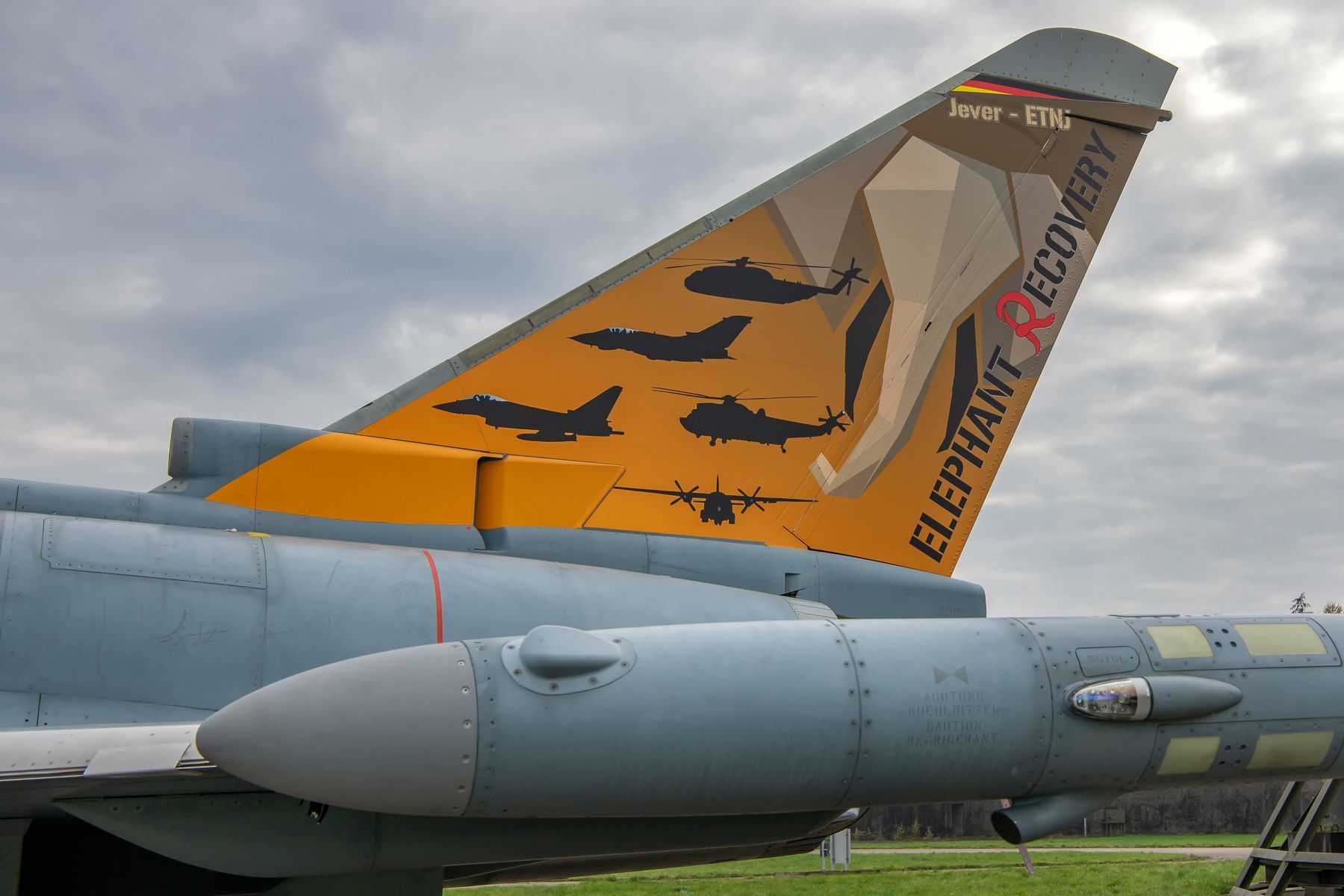
As the new operator for the Eurofighter, the Objektschutzregiment der Luftwaffe “Friesland” uses the aircraft for a few different roles. One of these is the so-called Elephant Recovery. In case an aircraft has ended up off the runway or taxiway following an incident or emergency, a team of the regiment is able to salvage the aircraft back to solid ground. This skill is frequently trained at Jever, for which beside the Eurofighter some other aircraft – all retired from operational use – are available as well. Following the reassembly of 30+04’s vertical fin at Jever, a special foil was applied to it, highlighting its new role and the various aircraft and helicopters available for such training.
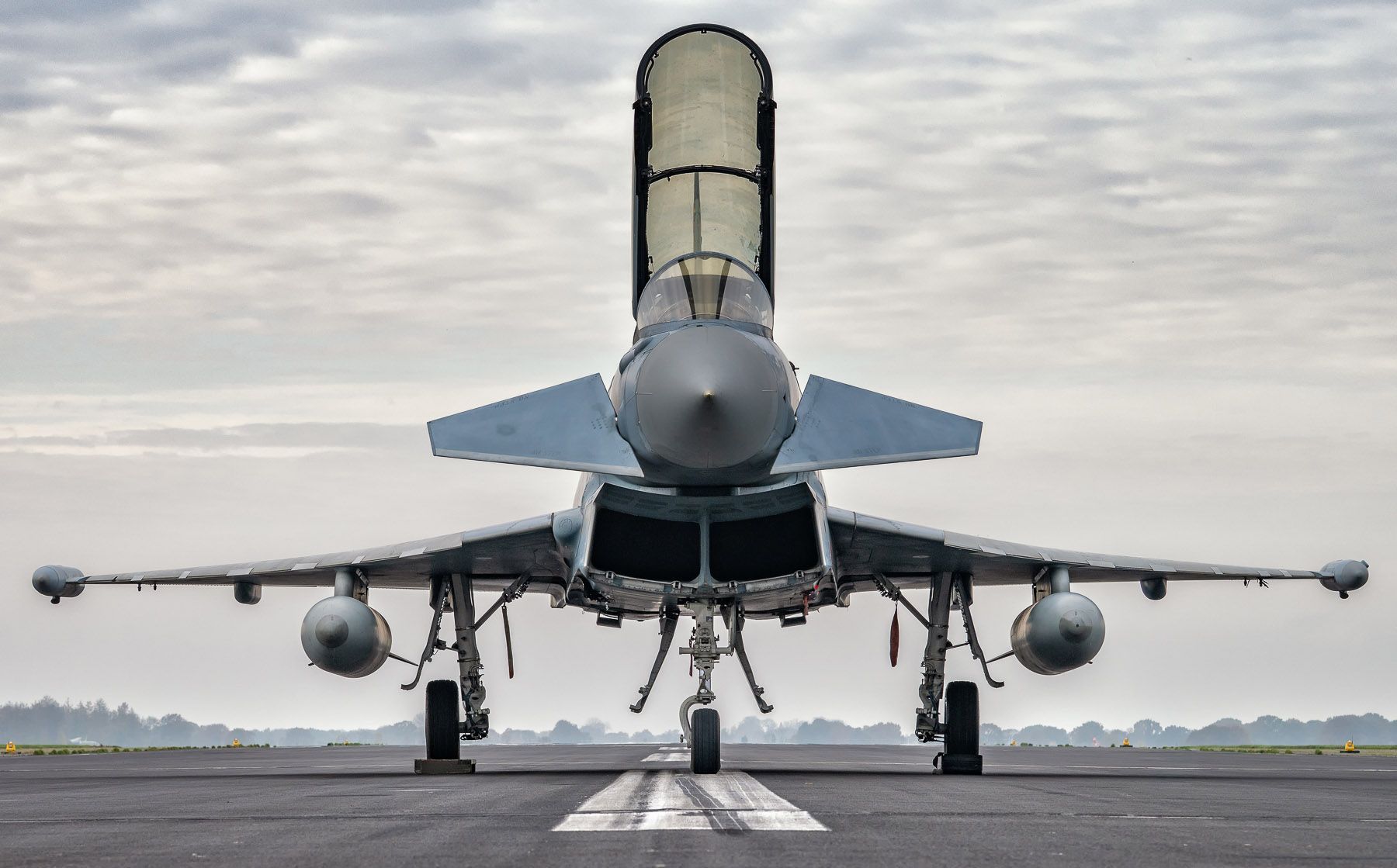
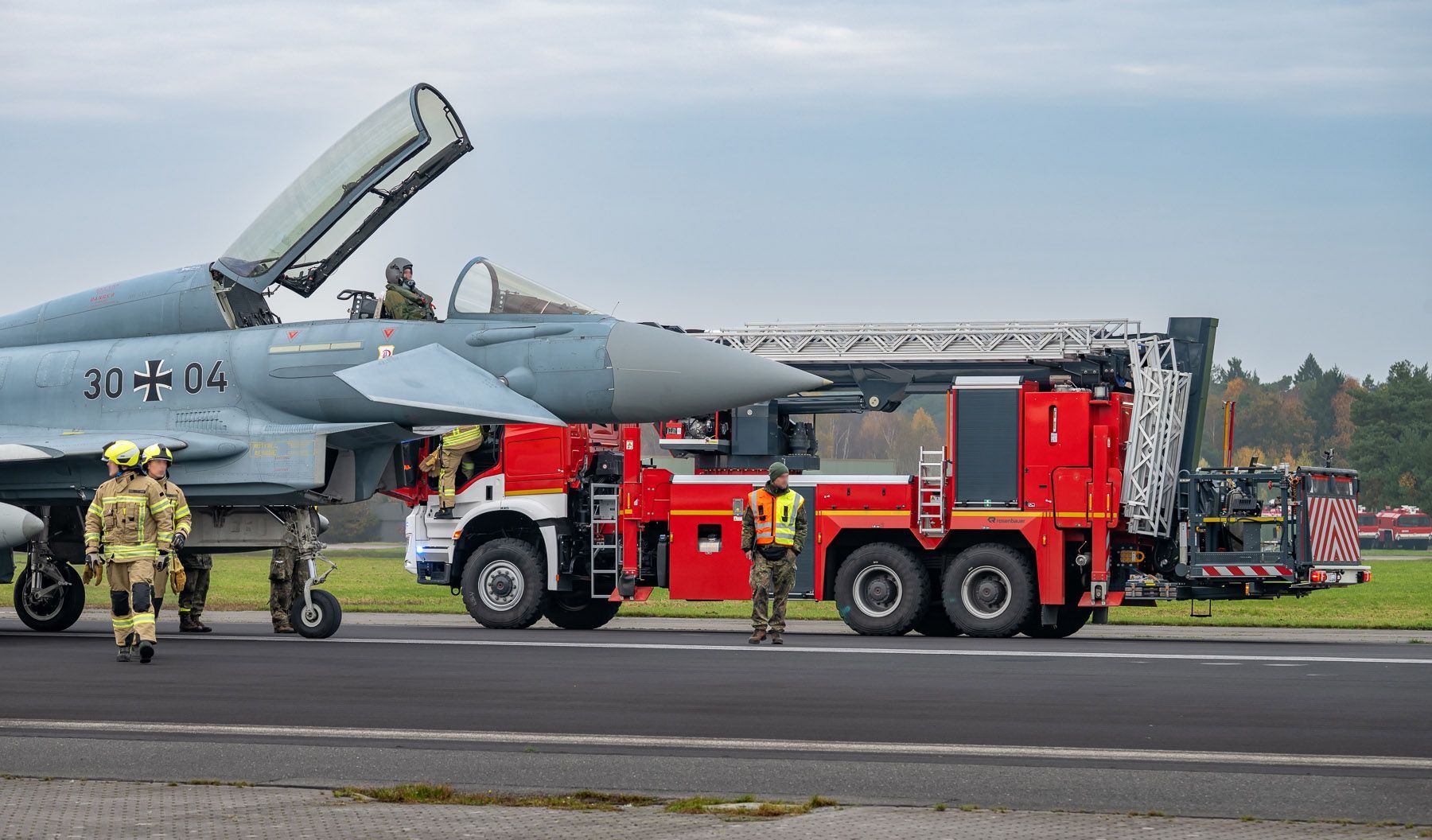
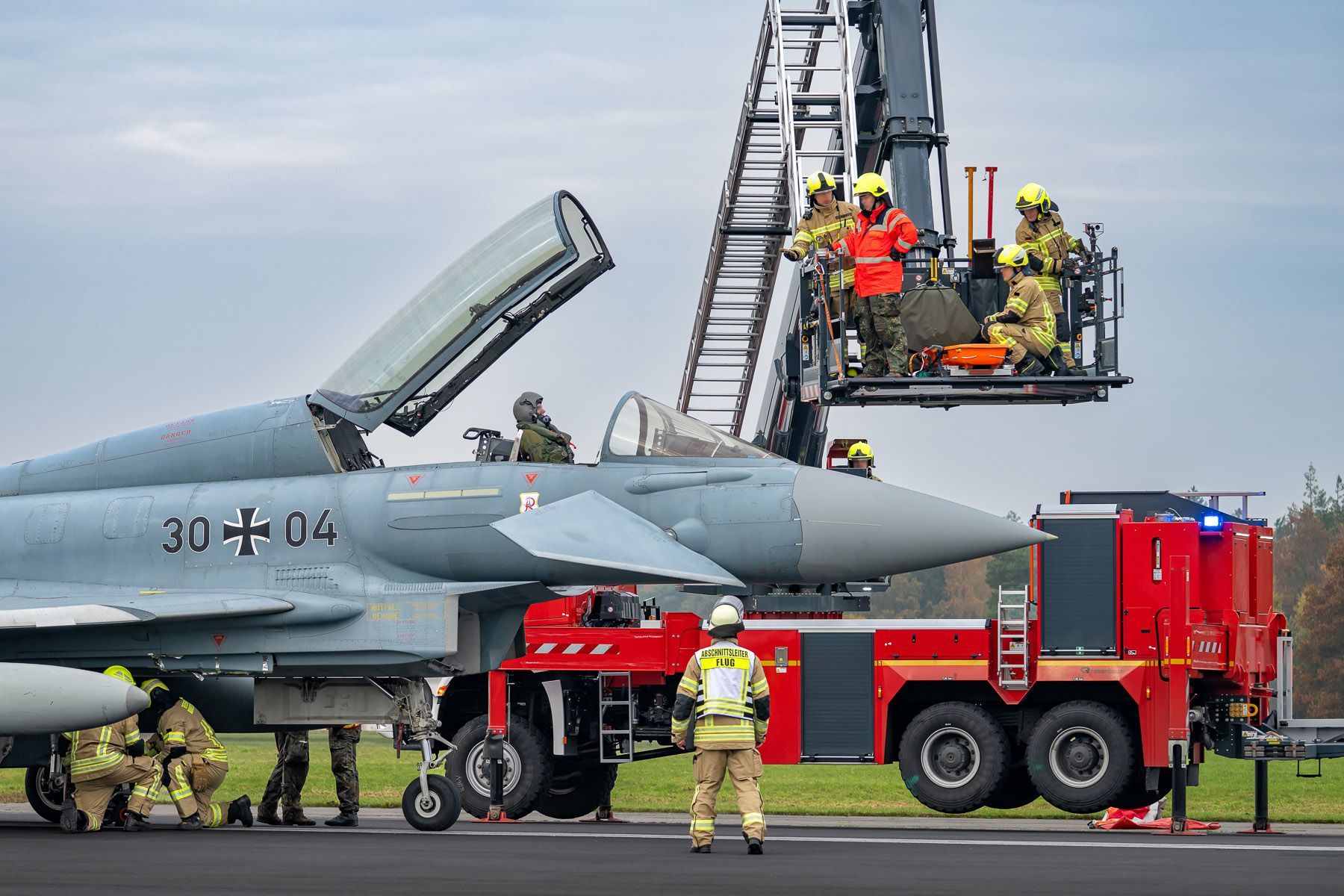
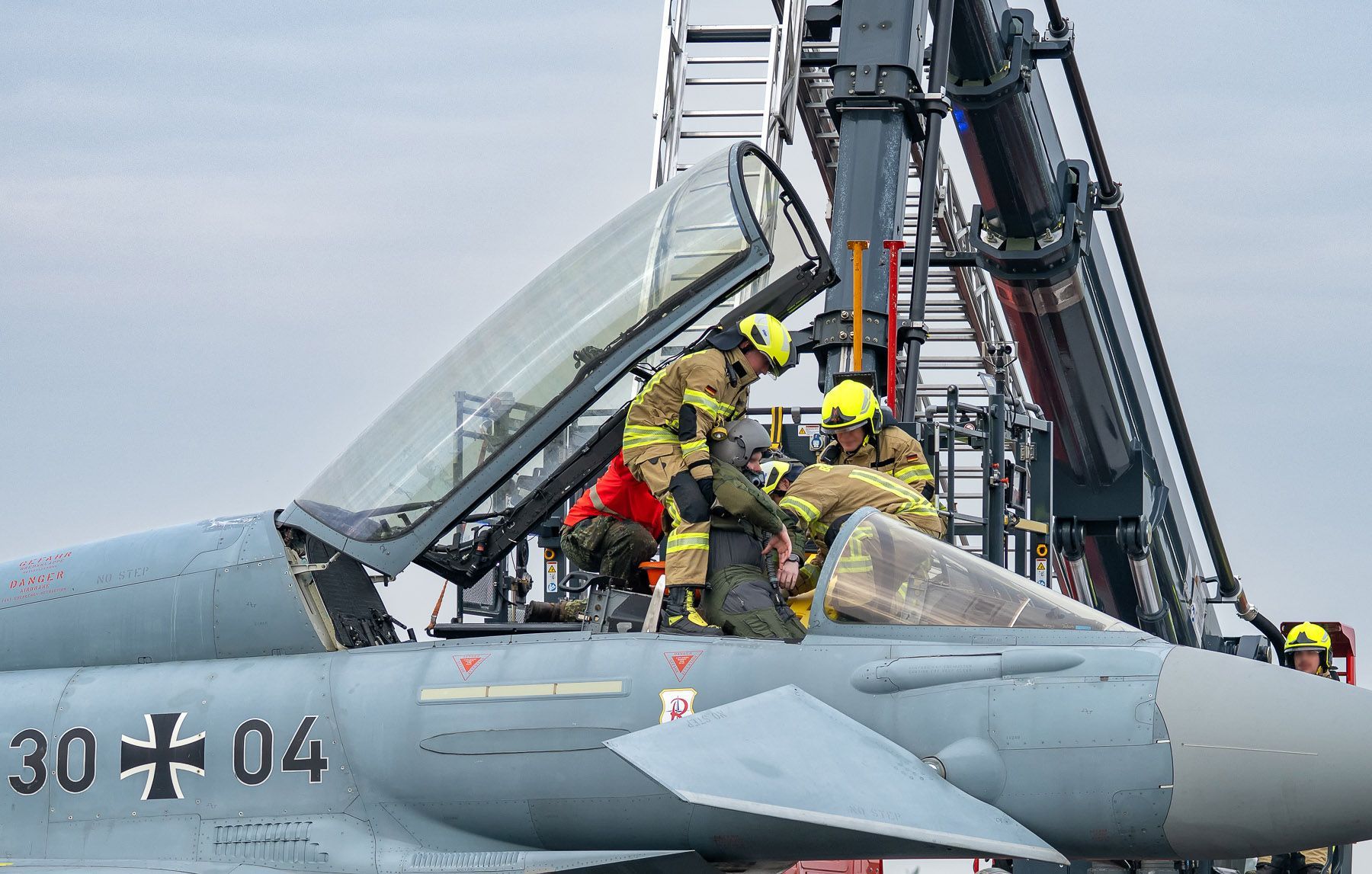
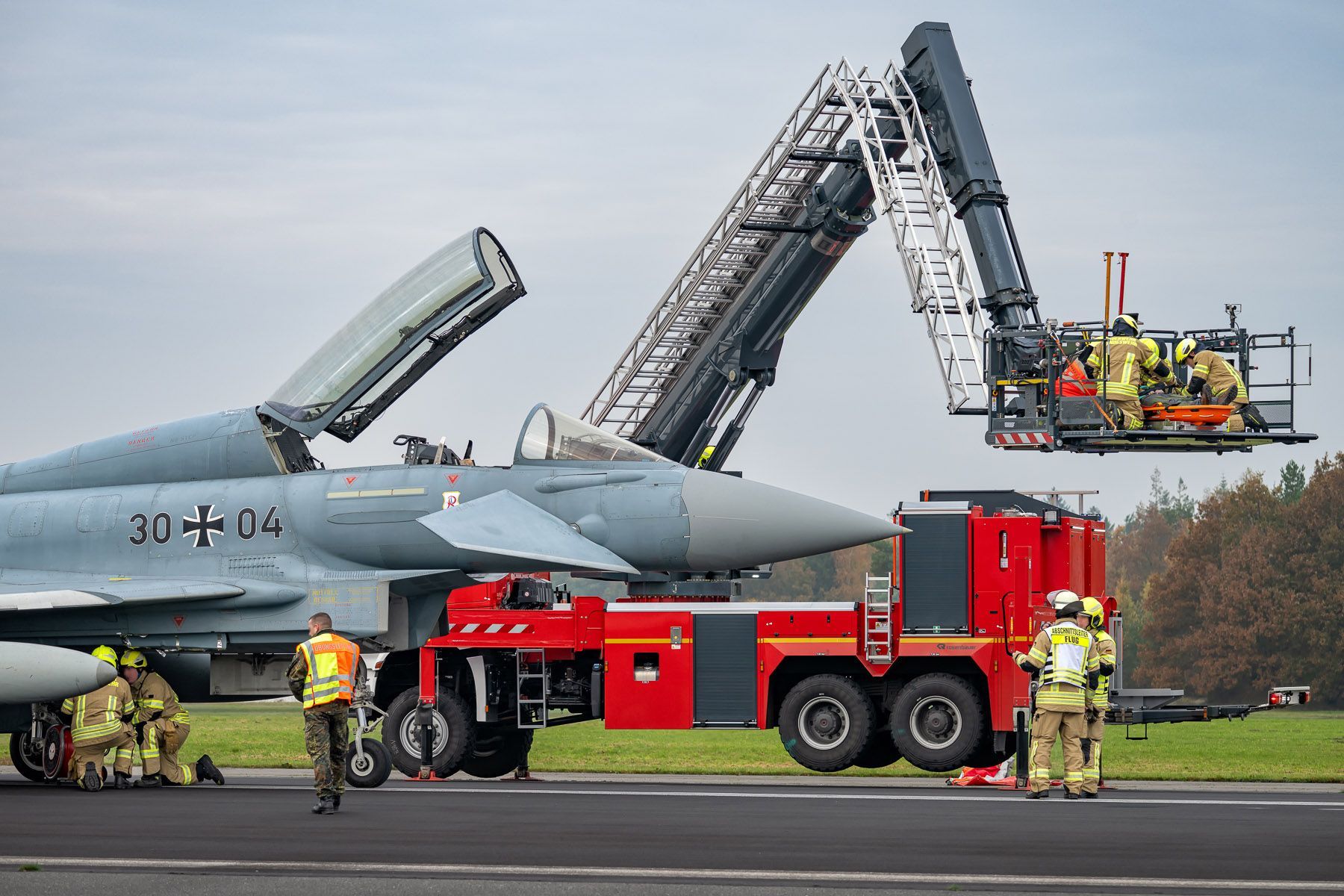
Another role for 30+04 is to act as training platform for firefighters and medical personnel. During a recent exercise, the Eurofighter played a significant part.
Red Rooster
The Objektschutzregiment der Luftwaffe “Friesland” hosted Exercise Red Rooster 2026 from 9 till 19 November 2026. In a virtual scenario, a clash between a NATO state and a neighbouring hostile country erupted over a certain border area. Jever air base was virtually placed just outside that region, serving as an alternate airbase that had been secured by the Objektschutzregiment. For the exercise, several scenarios were developed with increasing difficulty levels, involving amongst others the use of firefighter and medical personnel. Regarding the former, it must be noted that the Objektschutzregiment has its own corps that can be deployed abroad for international Bundeswehr operations. Other Luftwaffe air bases rely on civilian firefighting personnel and equipment and were therefore not part of the exercise.
On the first day of Red Rooster 2026, Eurofighter 30+04 supposedly encountered a hard landing resulting in a severe back injury for the pilot, who was subsequently incapacitated. The first group of firefighters inspected and secured the aircraft by chocking the landing gear and to install the safety pins. After establishing the pilot was unresponsive, special equipment was called in for a swift but careful extraction of the crew member. Once outside and back on the ground, he was stabilised and then taken by military ambulance.
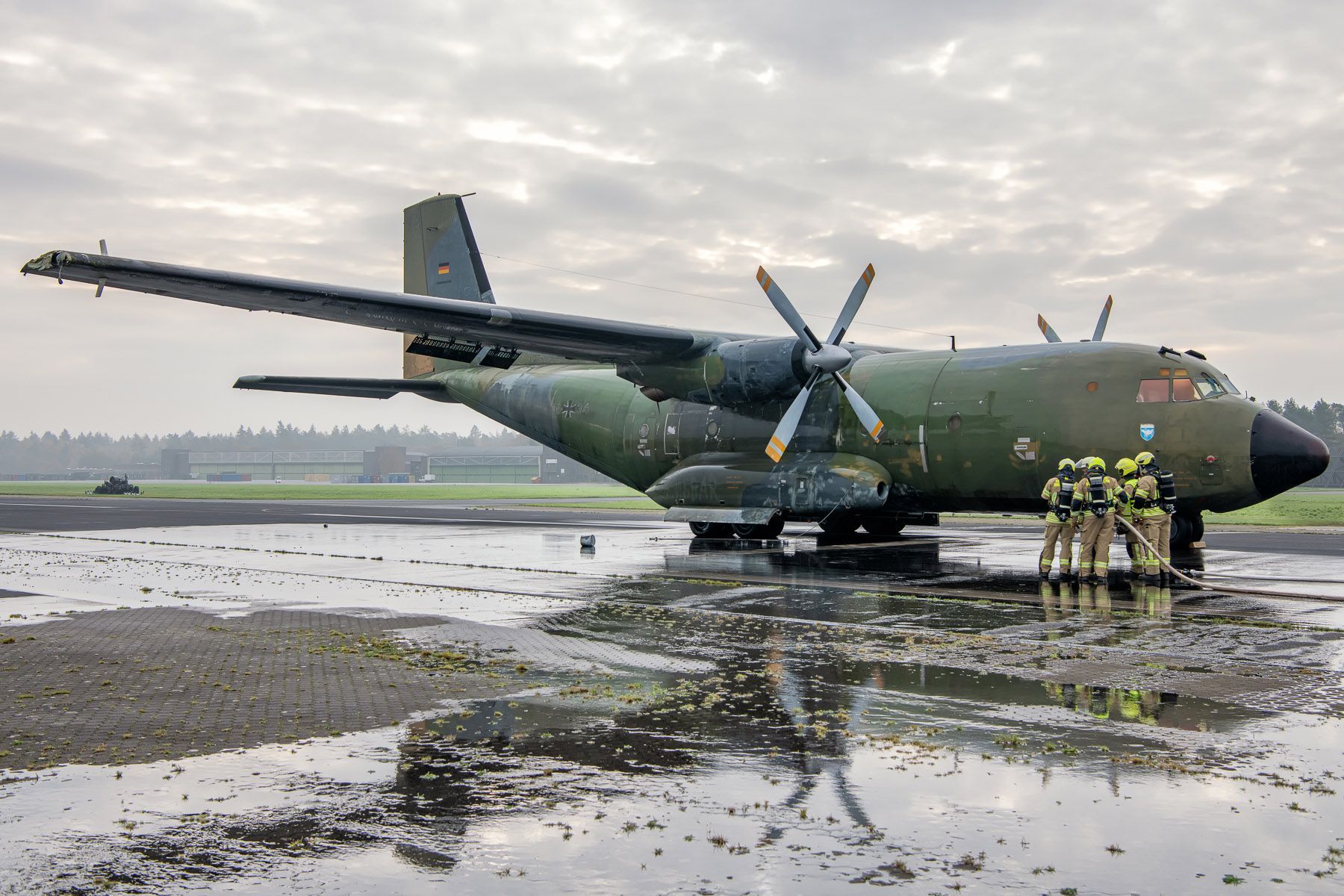
Additional scenarios were practised on the following days, with increased complexity. These exercises involved training for various aircraft emergency situations, with a focus on firefighting, technical salvage of the aircraft and possible weaponry, and again the safe and rapid recovery of crew members.
Following each training scenario, the applied procedures were systematically evaluated in a debriefing. During this process, the participating personnel discussed what worked well and where improvements were needed. These findings were immediately incorporated into future training.
High and dry
As part of the first tranche of Eurofighters for Germany, 30+04 is not the only example of re-use after retirement from flying. One is preserved at the Luftwaffe Headquarters in Berlin, another serves as training aid for future ground engineers, and some are being used as load trainers and spare part donors at various Eurofighter bases of the Luftwaffe. These examples might be covered in a future report.
With many vital parts removed, 30+04 is merely more than a hull. Nevertheless, to make sure the Objektschutzregiment der Luftwaffe can use the Eurofighter for a prolonged time, the aircraft is carefully stored. Together with one of their Tornados, it is parked in one of the Hardened Aircraft Shelters that are still available from the Cold War period. Jever closed down as active airbase in September 2013, but due to the current situation in the world, it will be reactivated to a certain extent. A mobile control tower and ditto runway lighting can be used, and cable barrier equipment has been reinstalled near both runway ends. No permanent flying unit is foreseen to be stationed here, but it will be made available as alternative and for temporary deployments. The first of these was already conducted in August 2026 during a so-called Agile Combat Employment (ACE) exercise dubbed “Richthofen Shield”. Four Eurofighters from neighbouring Wittmund deployed to Jever flying several local missions. Meanwhile, sister ship 30+04 proves to continue its very useful duties at aerodrome height. ■
The author would like to thank Oberstabsfeldwebel Markus Seiler, Press & Information Officer for the ObjSRgtLw “Friesland”, for his great assistance in this article.