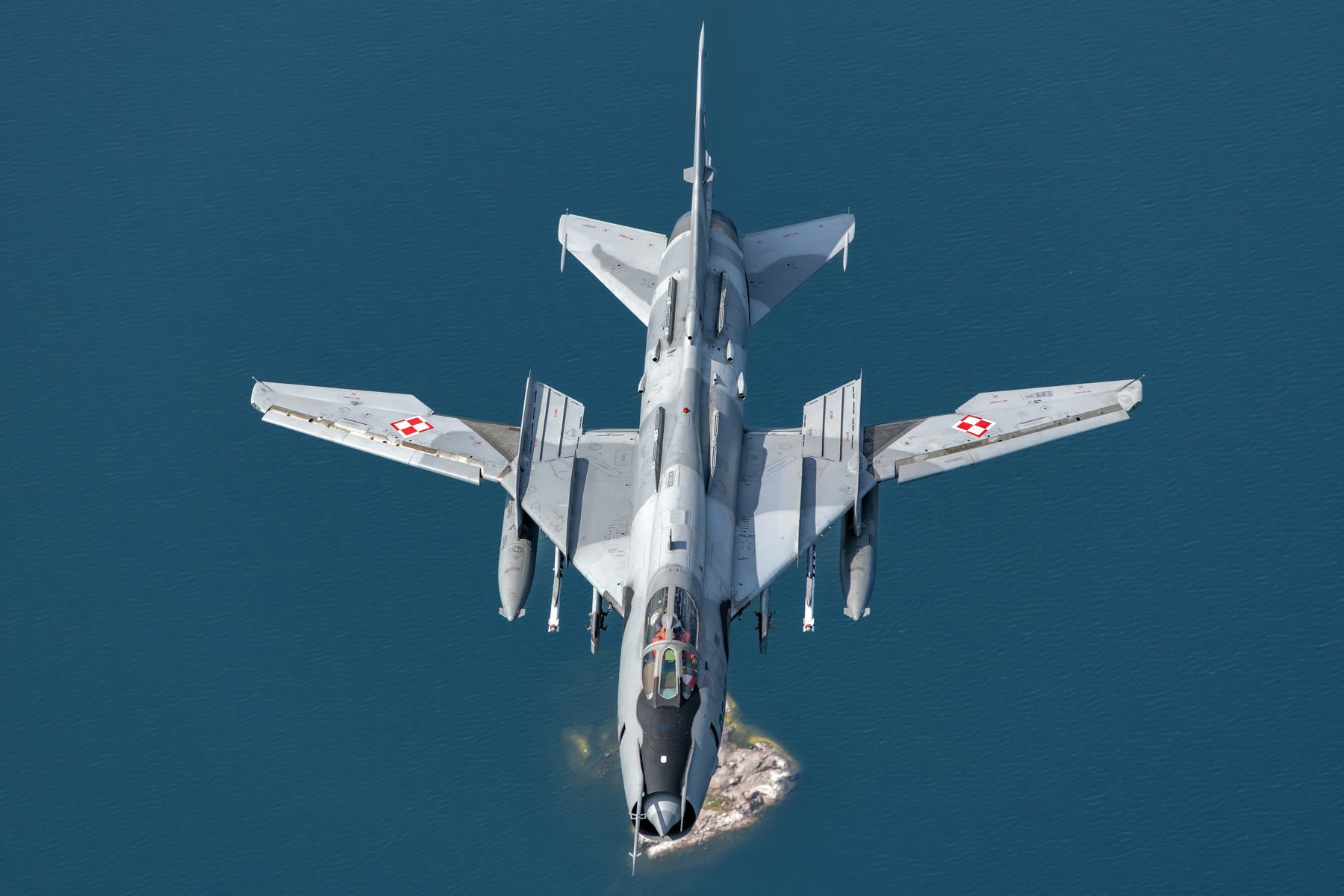
As the export version of the Sukhoi Su-17, the Soviet Union delivered the Su-22 (NATO codename ‘Fitter-K’) fighter-bomber to all countries of the Warsaw Pact but Romania. By numbers, Poland was by far the largest operator, and also was the very last one that still operated the type until retirement in 2025. This report highlights a detailed description of the aircraft’s systems as well as a brief history of its operations with the Polish Air Force.
Text and photos: Emiel Sloot
Published 27 October 2023 - last updated 17 April 2026
Regiments become squadrons
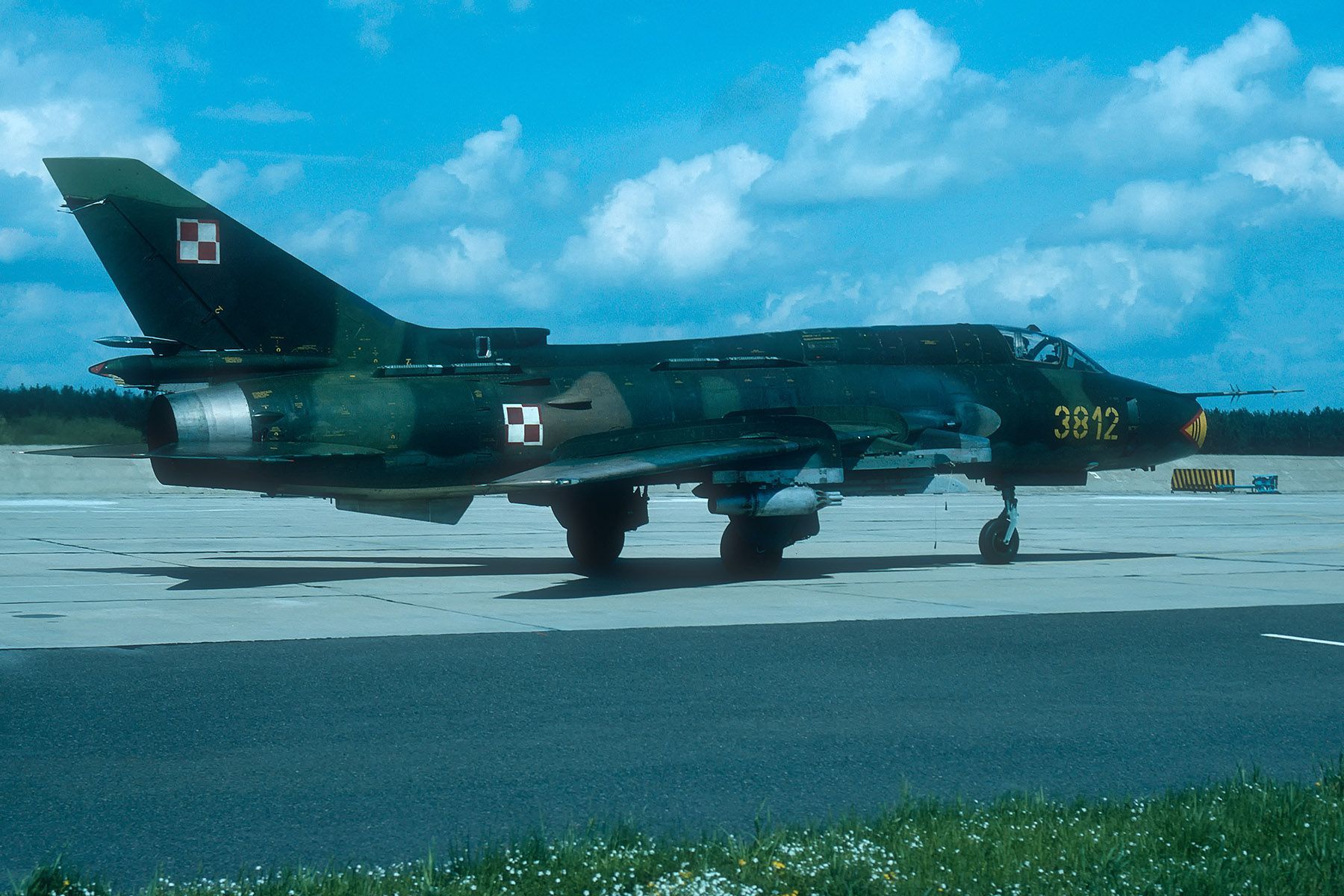
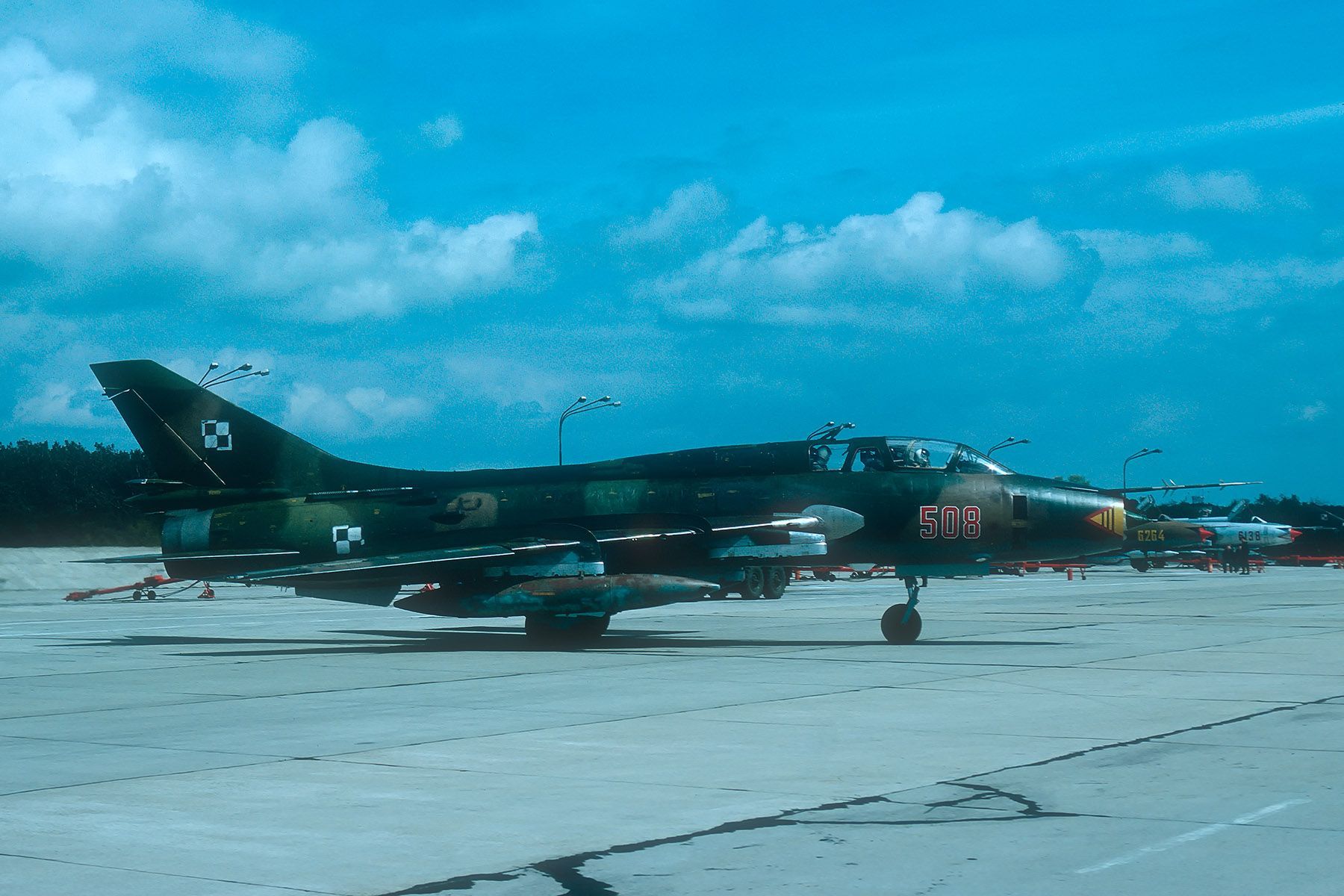
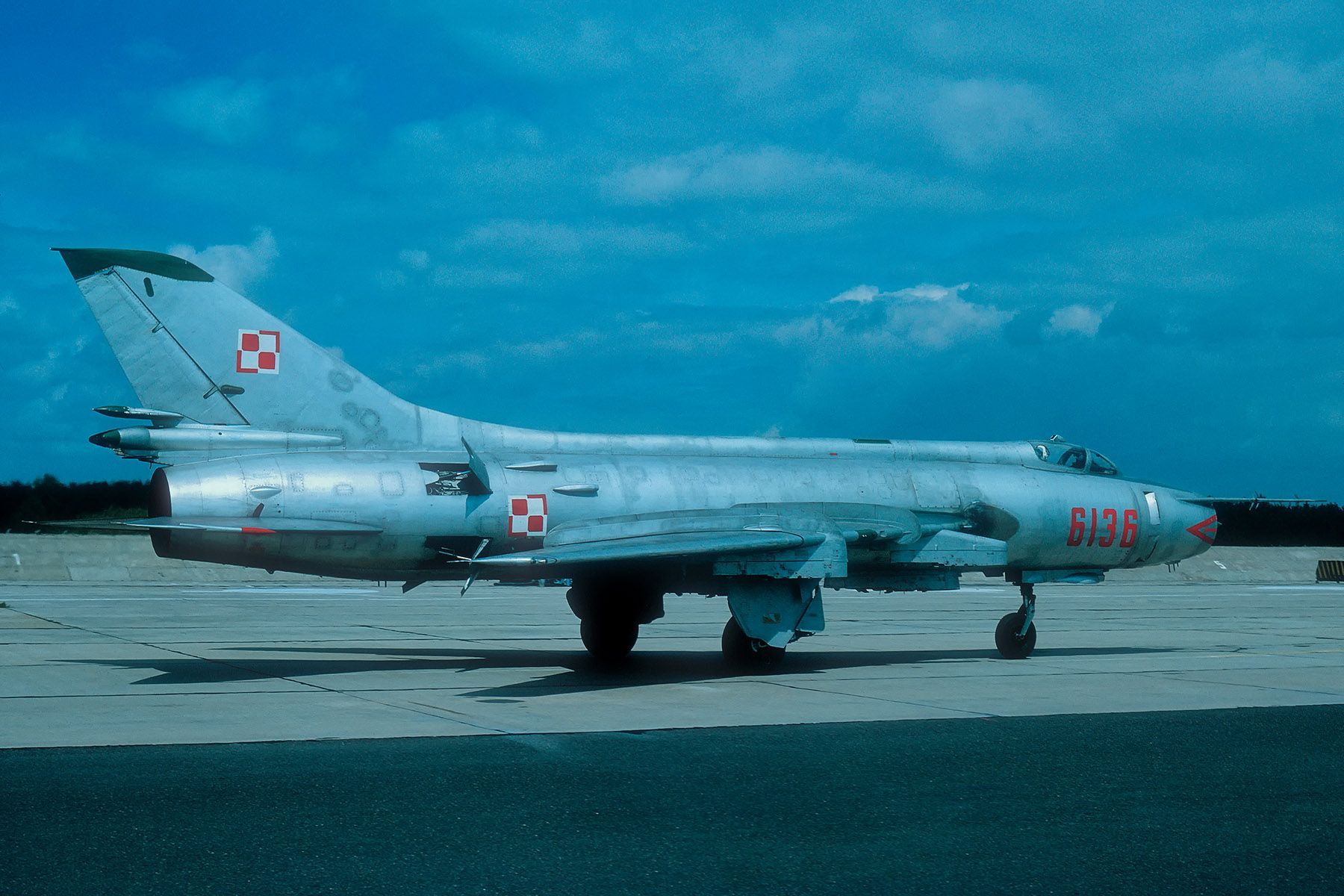
When the Sukhoi 22 entered service in Poland, the era of Glasnost and Perestroika – the harbinger of the end of the Cold War – was already blossoming. The first aircraft arrived on 28 August 1984, and a total of 110 aircraft would eventually be delivered, consisting of 90 Su-22M4 and 20 dual-seat Su-22UM3K.
Jacek (rank and surname withheld for security reasons), a now former operational Su-22 pilot with the Siły Powietrzne or Polish Air Force, lists the regiments that initially operated the type: “The first unit that was equipped with these aircraft was the 6 Pułk Lotnictwa Myśliwsko-Bombowego (6 PLMB – 6th Fighter-Bomber Aviation Regiment), based at Piła. By the way, this regiment disbanded in 1998 and its aircraft were divided among the remaining regiments. Next were the 40 PLMB at Świdwin and the 7 Pułk Lotnictwa Bombowo-Rozpoznawczego (7 PLBR – 7th Bomber and Reconnaissance Aviation Regiment) at Powidz. The final unit to receive the type was the 8 PLMB, based at Mirosławiec.”
In 1999, Poland joined NATO and the air force’s organization was restructured by adopting a squadron-based line-up that replaced the regiments. Squadron strength was enlarged to 16 aircraft, compared to 12 for the squadrons that fell under the former regiment structure.
On 1 January 2000, 7 PLBR transformed into 6 and 7 Eskadra Lotnictwa Taktycznego (6. and 7. elt – Tactical Aviation Squadrons), 8 PLMB continued as 8. elt, while 40 PLMB split into 39. and 40. elt. Since the fleet of Su-22s was gradually reduced following the end of the Cold War and the subsequent integration of Poland into NATO, several units were terminated such as 39. elt in 2003 and 8. elt on 30 June 2010. Earlier, in 2006, 6. elt had left Powidz for Poznań-Krzesiny to operate new Lockheed Martin F-16Cs while 7.elt relocated from Powidz to Świdwin in 2007.
“The 40 Eskadra Lotnictwa Taktycznego at Świdwin was the last remaining Su-22 squadron of the Polish Air Force. From 2010, its home base Świdwin became known as 21 Baza Lotnictwa Taktycznego or 21st Tactical Air Base,” explains Jacek. “The base controlled two aviation squadrons that together operated 18 aircraft, being twelve Su-22M4 and six Su-22UM3K.”
From approximately 2023, when the type's retirement was approaching, the dual seat aircraft were no longer required for conversion training. “Due to the upcoming withdrawal of the type and the ongoing transition of Polish pilots to new types of aircraft, there were no new pilots in training. The amount of flying hours logged by the last Su-22 pilots, largely depended on the experience level of each individual pilot,” says Jacek.
Self-defence and reconnaissance
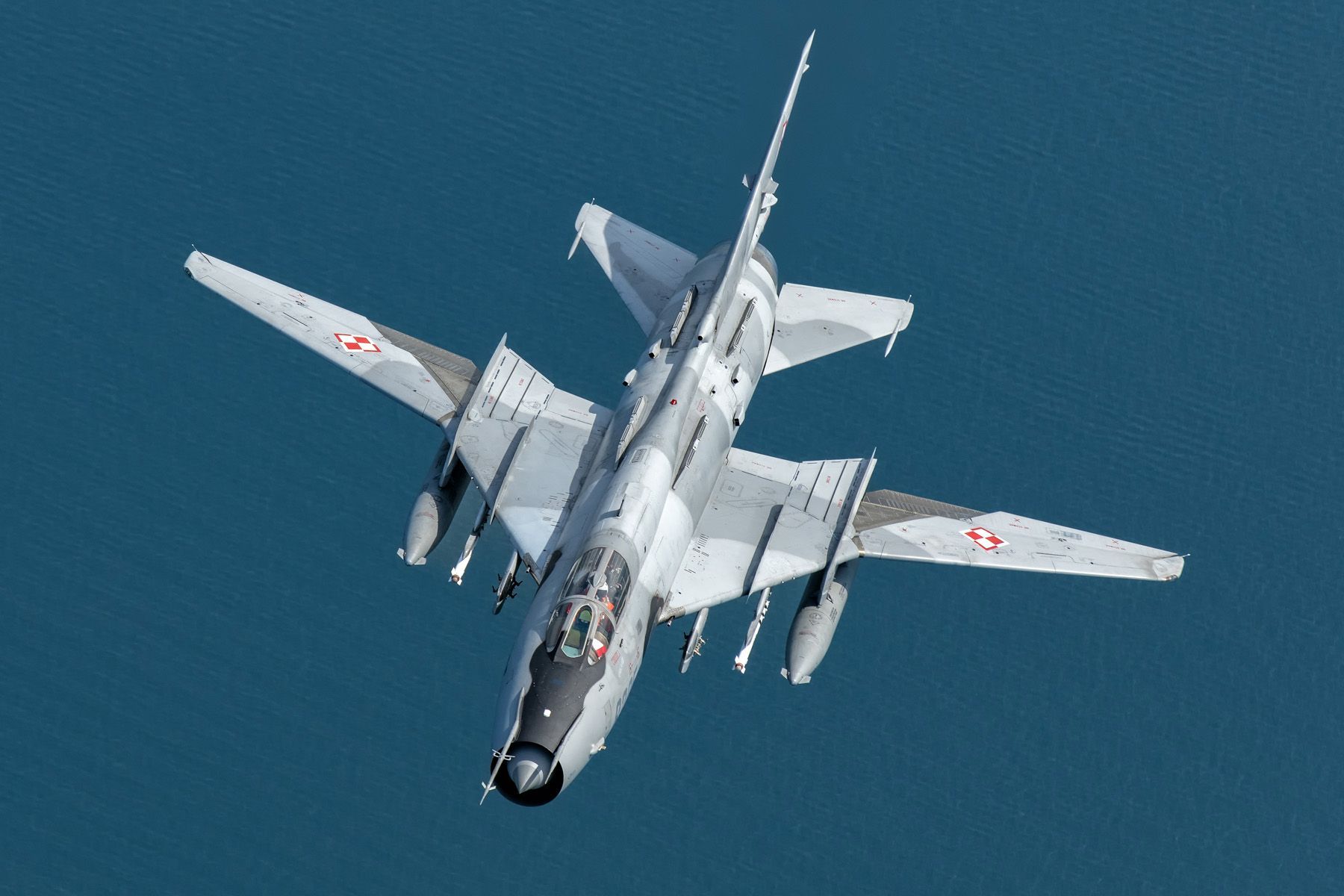
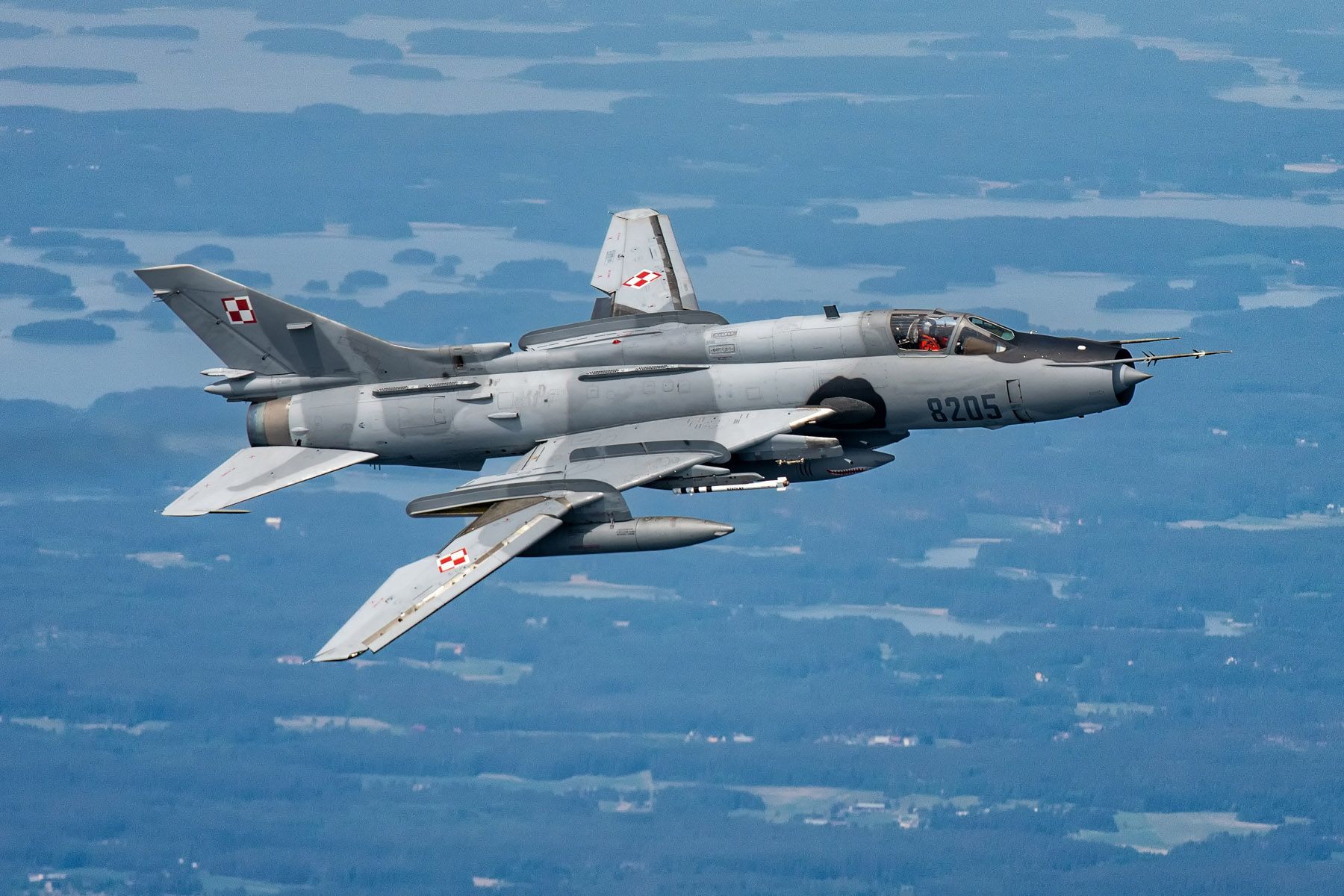
Although the Su-22 operation and systems were compatible to NATO standard to a certain extend, the aircraft also still featured several Soviet-style systems. Jacek describes a few of these. “First of all, Polish Su-22s did not have any radar or laser designator. However, we did have the Klen-PS integral laser rangefinder, which improves aiming of ballistic munitions. For electronic counter measures, we had the external SPS-141 pod that covered both the front and back of the aircraft and was able to jam ground as well as air threats, but only for self defence. We also had the SPO-15ŁM radar warning receiver, able to inform the pilot about the type of radar; the direction of the threat; the relative position – above or below; defining the radar that is the most dangerous; and the mode of radar, either lock or search. And then there was the ASO-2W chaff/flare system, located on the upper side of the fuselage, which functions in either automatic or manual override mode.”
“For our aerial reconnaissance task, we still used the KKR-1 external pod until the end. It was fitted with an A-39 day camera, a PA-1 panoramic day camera and a UA-47 night camera that works with flares. The system also had a radar transmitter/receiver module that was able to define the precise position of all surveillance radars working in wave lengths of 1.5 to 3 cm. At an altitude of 10,000ft (3,280m), it had a range of 160NM (296km). To allow our Su-22s to operate more easily alongside other NATO aircraft, the remaining airframes were modernized some years ago and received new avionics, new radios and an IFF/transponder, although the latter lacked Mode 5.”
Soviet-style weapons
In view of ordnance, the list of hardware was rather old-style like the before mentioned systems. Guided missiles or bombs were missing from the catalogue. “In order to carry western-produced munitions, additional modernizations would be required,” says Jacek.
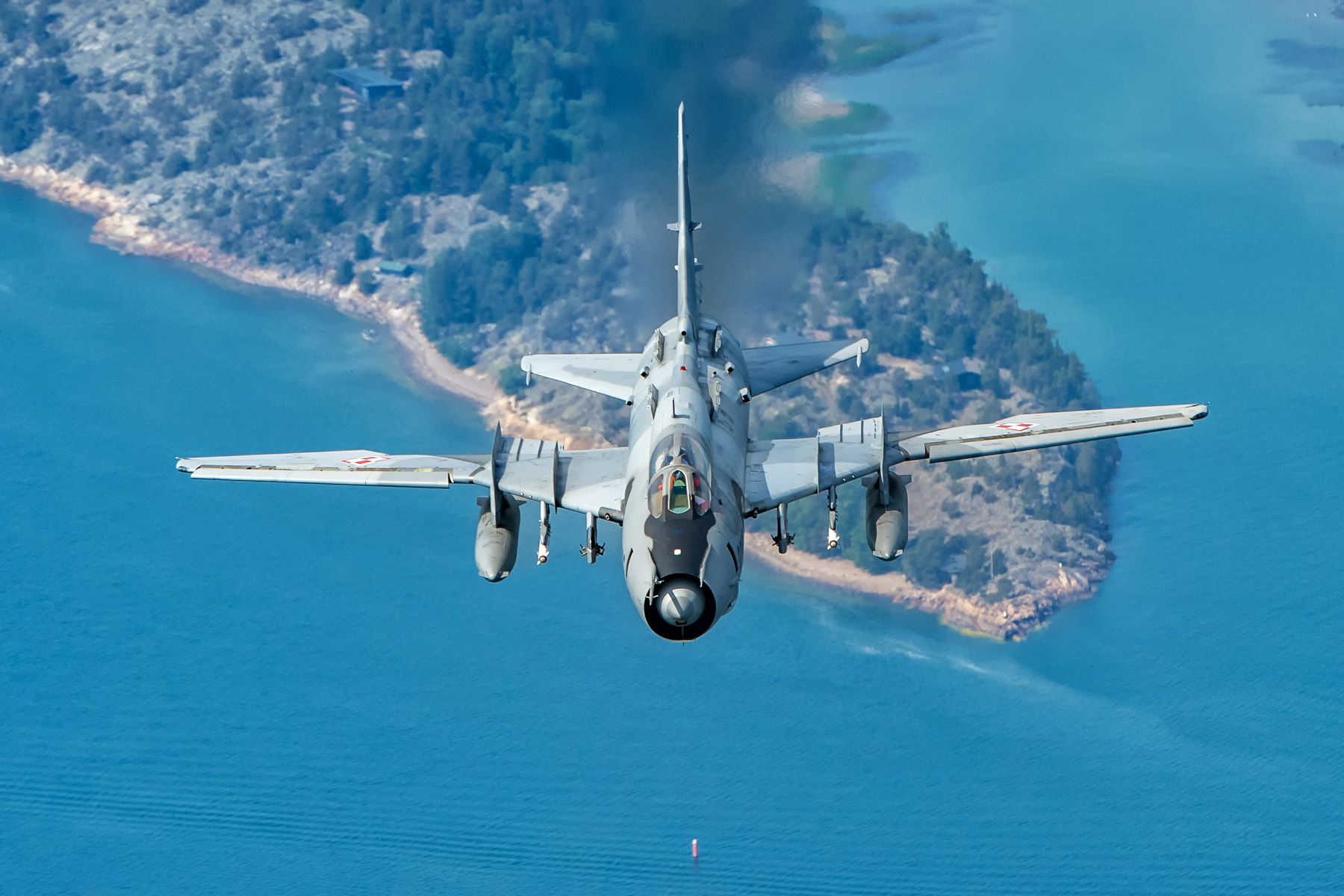
The options to arm the aircraft were still considerable. “First, we had two internally-mounted NR-30 guns. These contained 80 rounds each of 30mm cartridges that fired at a rate of 850 rounds per minute. In addition, we could carry up to four GSz-23 gun pod that each contained two 23mm guns with 260 rounds, firing at a rate of 3.400 round per minute. The GSz-23 had three different modes of firing, including a backward mode. For additional self defence, two R-60 ‘Aphid’ infrared missiles could be mounted, having a maximum range of 4NM (7.4km).”
A variety of inert bombs and rockets was available to support the aircraft’s primary role as a fighter-bomber. “Either 20 FAB-100 (100kg), 10 FAB-250 (250 kg) or 8 FAB-500 (500kg) unguided bombs could be carried, while the INS navigation system provided a correction to the weapon system resulting in an accuracy of up to 30m for pre-programmed targets. And, up to six launchers could be fitted that each contained either 16 or 32 S5 unguided rockets. These had a calibre of 57mm and a range of 0.6 to 1NM (1.1 to 1.8km).”
The Su-22 could also carry the KMGU cluster dispenser. Although a large number of countries have signed the Convention of Cluster Munitions treaty to ban this kind of weapons, Poland has not done so.
Flying characteristics
Withdrawal of the Su-22 in Poland was initially planned for 2014. However, as the purchase of a replacement attack platform was postponed, the Ministry of Defence decided to keep a small number of Su-22s on duty, following an update programme. This particular project was approved in 2015, covering the 18 aircraft that were still in service until the end. The programme included the installation of an RS-6113-2 VHF/UHF radio, for which a new blade antenna was mounted on top of the fuselage. Other new avionics included TACAN, ILS and GPS. Furthermore, a new flight parameter recorder was installed, while new cockpit instruments indicating in international standard aviation units like knots and feet replaced the older metric ones. Finally, the fleet was resprayed in a new grey paint scheme replacing the old camouflage pattern. The upgrade was carried out by Wojskowe Zakłady Lotnicze 2 (WZL-2 – Military Aviation Plant 2) at Bydgoszcz.
Jacek expresses a positive impression on the Su-22’s specific handling characteristics as a pilot, although he would qualify these as demanding. “When flying the aircraft, the stick forces were very high. The wings were endowed with heavy mechanics and featured large inboard flaps for take-off and outboard flaps for landing. The variable wing geometry required much attention, as the pilot must take into account several operational limitations related to the position of the movable section of the wing and its high-lift devices. The automatic flight control system, although aiding the pilot in many situations, was not fly-by-wire and thus not very pilot-friendly. However, a well-trained pilot was able to get much out of the aircraft. The aircraft handled very well in low-altitude high-speed flight, providing good manoeuvrability during for example strafing flights. It could also attain pretty long range and endurance. Overall, it was a rugged, reliable fighter, and a very good platform for weapons delivery. The navigation and attack systems were vintage, but also virtually indestructible. The engine was also very old, but reliable with a remarkable resistance to FOD.”
Noteworthy was that the single-seat Su-22M4 had a slightly restricted maximum speed. This was caused by the fixed nose cone, compared to that of the dual variant. The nose cone of the -M4 housed the laser rangefinder and was therefore not able to slide forward during high speed to reduce the intake air flow.
The end
With the aircraft nearing the end of their service career, the final Su-22 unit joined a number of international exercises with their updated aircraft. “Polish Su-22s participated in exercises like Ample Strike and Spring Storm in Estonia, and Hedgehog that took place in 2022 along the Estonian-Latvian border. We also participated in Exercise Aurora in Sweden in 2023, says Jacek. “When the fleet was modernized between 2015 and 2017, the aircraft’s service life was extended for another 800 flying hours and 1,200 landings, or 1,600 landings for the two-seaters.”
“The 21st Tactical Air Base will receive both a squadron of Lockheed F-35A Lightning II and one with the KAI FA-50. Given the roles of the Su-22, the FA-50 can be seen as its natural replacement,” Jacek concludes.
In 2022, Poland ordered 12 FA-50GF block 10 and 36 FA-50PL to replace their Su-22s and MiG-29s. By 2023, the first FA-50s were delivered to Poland. The Su-22s relocated to 12 Baza Bezzałogowych Statków Powietrznych (12 Unmanned Aerial Vehicles Base) at Mirosławiec. From here, a three-ship flypast was conducted over all former Polish air force Su-22 bases on 10 September 2025, with the very last flight carried out the next day during a farewell ceremony. The final landing marked the end of this remarkable Cold War machine over Europe. ■