Eurofighter in service with Germany's Luftwaffe
Part 4: Bundeswehr Eurofighter units
Below is a list of Luftwaffe units that operate the Eurofighter, mentioned in chronological order in view of taking these on charge. Also listed is one that was supposed to get these aircraft but eventually never did. For most units a compact unit history is included, and also mentioned are various international exercises in which was participated involving Eurofighters. Not in the list is Airbus, so I’ll mention it here briefly: at Manching, they operate two Instrumented Production Aircraft.
Text: Emiel Sloot
Photos: Emiel Sloot (unless stated otherwise)
Last updated: 16 September 2026
Technisches Ausbildungszentrum der Luftwaffe – Abteilung Süd
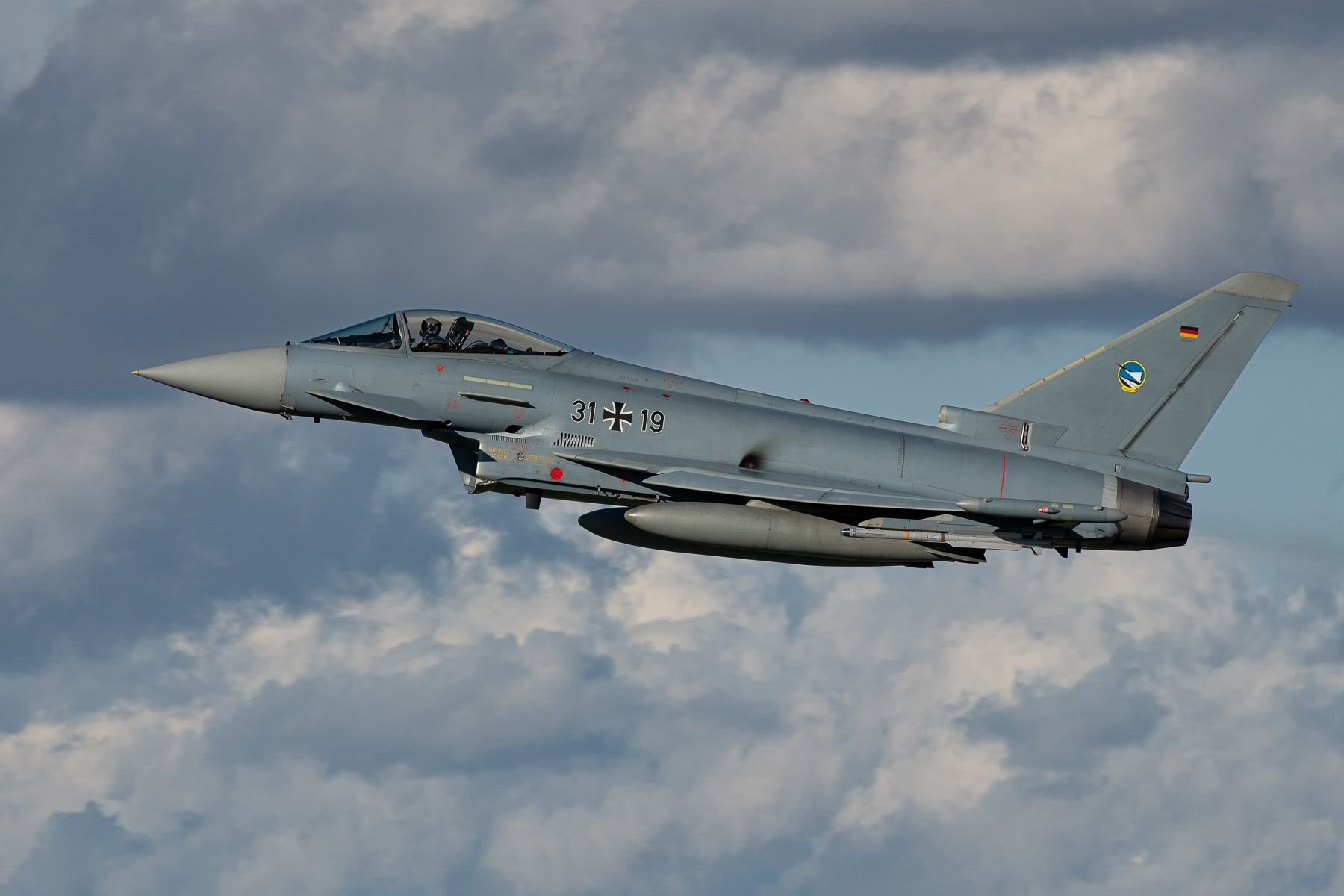
The first Luftwaffe unit to ‘operate’ the Eurofighter was the air force’s technical school, the Technische Schule der Luftwaffe 1 based at Kaufbeuren. The very first production Eurofighter GT0001, two-seater 30+01 (still registered 98+31 at that time) landed here on 17 February 2003 and was hangared for training, having only very few flying hours logged. Two more single-seat aircraft (GS0002/30+07 and GS0013/30+22) soon followed.
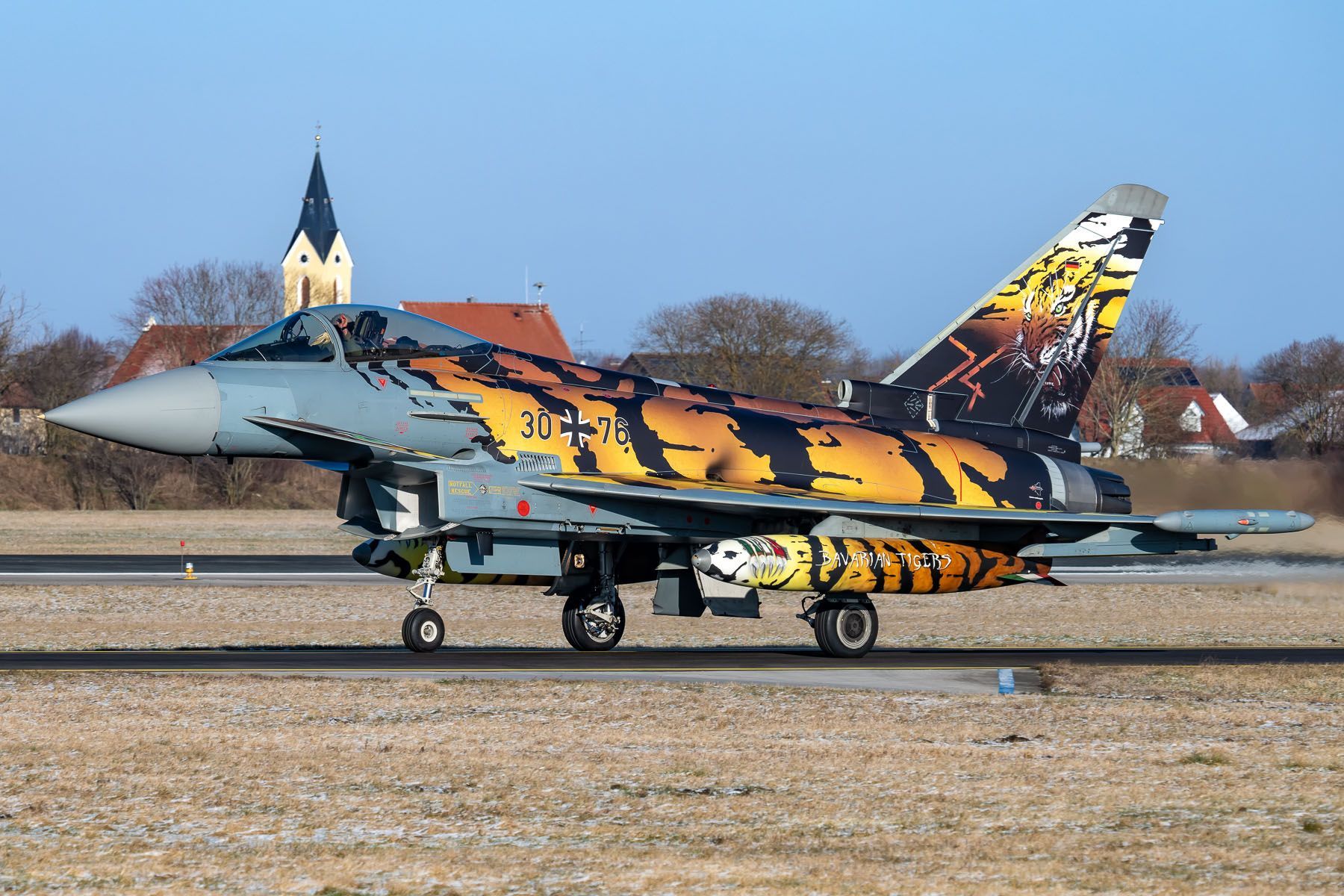
While in service with TaktLwG 74, GS0004/30+09 – painted in special colours known as the Bronze Tiger – would be the first Luftwaffe Eurofighter to reach 1,200 flying hours. Instead of undergoing its next 400 hours inspection at Manching, the aircraft was flown to Kaufbeuren to serve as ground instructional airframe.
The school was renamed Technisches Ausbildungszentrum der Luftwaffe – Abteilung Süd on 1 January 2014. It has three Eurofighters available for training aviation technicians. Except for 30+09 that has become a long-term resident, others have rotated throughout the years. In the past, these aircraft landed at Kaufbeuren for a multi-year tour of training duty, and after that these were transported by road to Manching for inspection and overhaul, before returning to flight status. Because the runway at Kaufbeuren is no longer suitable to handle fast jets, Eurofighters now have to land at nearby Lechfeld and continue by road transport for the last stretch.
Historical reference: TSLw 1 was established at Kaufbeuren in December 1957. Over the years, future technical personnel could educate their skills on a number of jet aircraft aircraft types, including the F-104G Starfighter, F-4F Phantom and Tornado. On 1 January 2014, both TSLw 1 and the Fassberg-based TSLw 3 merged into the Technische Ausbildungszentrum der Luftwaffe, the Kaufbeuren branch referred to as Abteilung Süd. Today it continues to serve as technical training centre for both Tornado and Eurofighter.
Taktisches Luftwaffengeschwader 73 'Steinhoff'
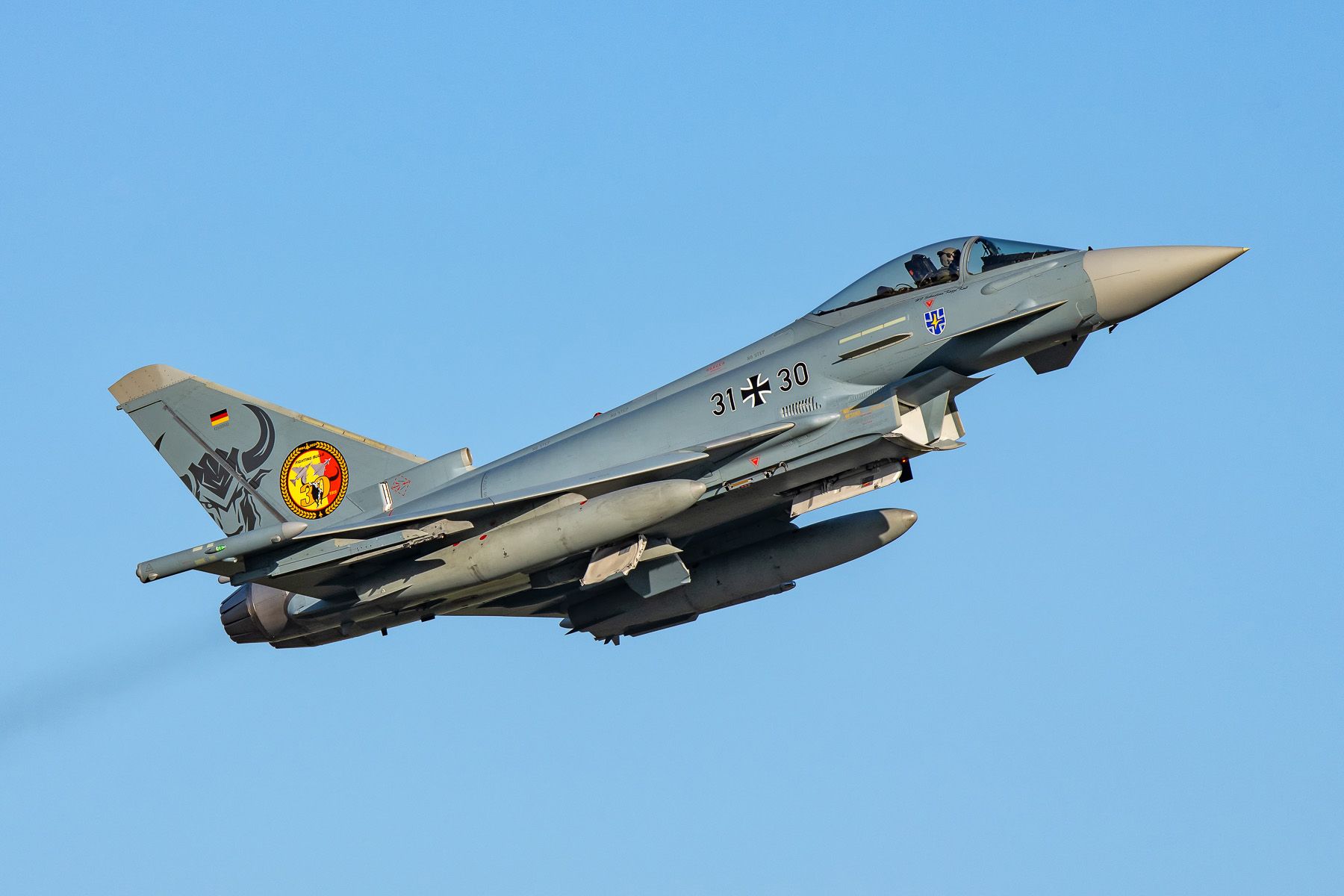
On 30 April 2004, Jagdgeschwader 73 officially received the first five dual-seat Eurofighters. These were initially used by a group of pilots that had converted to the new type at Manching, and conducted a 250-hour evaluation phase in view of tactical procedures from JG 73’s home base Laage. After completing this phase, the first conversion course was undertaken to certify new flight instructors for the type.
The aircraft were initially registered in the 98+xx range, since the full type certification had not yet been issued. After that occurred, all were reregistered in the allocated 30+xx range.
During Summer 2005, a German Luftwaffe (iron cross) marking was applied temporarily on the centre fuselage on GT0006/30+10 to explore the possibility to relocate the serial, to ease formation flying references. The idea was eventually not adopted. In the meantime, some aircraft flew with serial numbers not outlined in white awaiting the outcome of this trial, to prevent extra work. After the trial ended, all serials were indeed outlined.
Training was and is conducted by the 2nd Staffel (732 ‘Bulls’ squadron), formerly operating F-4F Phantom IIs. At that stage, the 1st Staffel still operated the former East German LSK-LV MiG-29s, mainly for DACT missions against various NATO units. Following the disposal of these fighters which were subsequently transferred to neighbour Poland, the 1st Staffel (731) was reactivated as a Eurofighter squadron on 17 January 2008. This squadron is training both flight instructors and weapon instructors while having an operational task as well.
The first international exercise was conducted from 10 till 14 March 2008 when three Eurofighters deployed to Morón de la Frontera, Spain for the so-called ‘Typhoon Meet’. The goal was to exchange experiences between the partner nations.
Another milestone was reached in February 2009 when three aircraft (GS0014/30+23, GS0015/30+25 and GT0014/30+38) joined the Aero India 2009 show for a daily air display. For the ferry flight, the Eurofighters were refuelled by a A310MRTT (10+27), marking the first such mission abroad.
JG 73 is not only the Luftwaffe Eurofighter Operational Conversion Unit, but also trains Austrian pilots as they lack two-seat aircraft. Initial Training Devices represent a basic cockpit setup, available for procedural training. Full Mission Simulators are used during the conversion course, and these Aircrew Synthetic Training Aids are also available at the other Eurofighter bases. In fact, these can be linked to train complex scenarios.
During 2010, the availability of Eurofighters had reached such a low level, mainly due to aircraft not available due to the R2 upgrade programme, that the Luftwaffe decided to concentrate most of the Eurofighter operations at Laage for one year, from 1 March 2010 until 25 February 2011. By this measure, continuation and training of both pilots and ground personnel was improved. Three aircraft from JG 74 were temporarily assigned to JG 73 (GS0004/30+09, GS0005/30+11 and GT0013/30+35) and during this centralisation period, some aircraft had the emblems of all three geschwaders (JG 73/JG 74/JaBoG 31) applied on the left side of the tailfin. The R2 programme was destined to be completed by 2011, although it would eventually run into 2012.
In 2012, the Bundeswehrreform (Armed Forces Restructuring) plan mentioned a relocation of Eurofighter pilot training to Holloman AFB, New Mexico from 2017. 24 Eurofighters would be based at Holloman AFB for this purpose. Then on 8 March 2013, Defence Minister Ursula von der Leyen floated another idea as she opted to move training to Wittmund instead of Holloman, while Laage would then house a fully operational wing. Eventually, in November 2013, it was decided to keep things as they were: training remained at Laage.
Jagdgeschwader 73 was redesignated Taktisches Luftwaffengeschwader 73 on 1 October 2013. Today, the Eurofighter conversion course with TaktLwG 73 takes some nine months with 70 sorties flown, both in simulator and actual. A class usually consists of eight students.
On 26 July 2024, three Eurofighters piloted by TaktLwG 73 crew flew the longest Eurofighter flight to date when they flew from Chitose AB, Japan to Hickam AFB, Hawaii non-stop. The distance of some 8,600km took 10:31 flying hours, while being aerially refuelled five times.
Historical reference: the wing’s origin traces back to a number of previous units. Established as Jagdgeschwader 73 at Oldenburg on 1 December 1959, it started operating the Sabre Mk.6. In 1961 it transferred to Pferdsfeld that would remain its home base for over three decades. On 1 October 1964, the unit adopted the ground attack role, changed into Jagdbombergeschwader 42 and received G.91R light attack aircraft. For some reasons however, the G.91 operation was postponed and the unit temporarily operated their Sabres again. In line with other G.91 operators, the unit was redesignated Leichtes Kampfgeschwader 42 and finally started its G.91 operations as of 1 May 1967. On 1 April 1975, the unit got yet another name as it now became Jagdbombergeschwader 35, in preparation of their operations with the F-4F Phantom II. In February 1993, JaBoG 35 changed into JG 73, completing the circle.
As a result of Germany’s reunification, it was decided to continue operations from the former East German air force and naval air base at Laage. Initially planning to relocate JG 72 from Rheine-Hopsten, in 1997 JG 73 moved instead and Pferdsfeld was permanently closed. At Laage, F-4Fs would operate alongside MiG-29s that had, as part of JG 73, relocated from Preschen in October 1994. The fighter types each formed a squadron within JG 73, until Eurofighters replaced both types.
On 18 September 1997, the unit was named ‘Steinhoff’ after WWII veteran and former post-war Inspector for the Air Force General Johannes Steinhoff.
Exercises etc. with JG 73 / TaktLwG 73 involvement
- 10/14 March 2008 - three aircraft were deployed to Morón de la Frontera, Spain for the ‘Typhoon Meet’. The goal was to exchange experiences with the new aircraft, and other participants were the Royal Air Force (4 aircraft from 3(F) and XI(F) Squadrons), the Italian Air Force (2 each from 9° and 12° Gruppi) and the Spanish Air Force (9 aircraft from Ala 11)
- 20/30 July 2009 - eight aircraft went to Decimomannu, Italy for the first large Luftwaffe deployment abroad with Eurofighter
- Febr/March 2010 - three aircraft flown to Banglalore, India for a promotion tour
- June/July 2010 - 16 aircraft to Decimomannu, including personnel and aircraft from JG 74
- 29 Feb/11 Mar 2016 - three aircraft to exercise DACT 2016 at Gando-Las Palmas, Spain
- 6/16 Nov 2017 - six aircraft joined Exercise Blue Flag at Ovda, Israel
- May 2023 - a visit with a few aircraft including the specially marked ‘Eagle Star 2.0 in view of the 75th anniversary of Israel
- 10 Oct/3 Nov 2023 - six aircraft joined the Desert Air Exercise in Jordan
- July / August 2024 - together with five aircraft from TaktLwG 71, three aircraft joined the large Pacific Skies 24 deployment around the globe. The TaktLwG 73 contingent participated in Exercise Arctic Defender (Alaska, 8/18 July), Exercise Nippon Skies (Japan, 22/25 July) and Exercise Rimpac (Hawaii, the exercise itself had already started on 26 June and ran until 2 August)
- 21 April/8 May 2025 - three aircraft deployed to Exercise Desert Flag at Al Dhafra, UAE
- 13/17 Apr 2026 - five aircraft deployed to Lübeck-Blankensee airport for Dispersed Operations 2026
- 22/26 June 2026 - three aircraft went to Ronneby, Sweden in view of Exercise Midsummer Brawl 2026, an Agile Combat Employment (ACE) exercise
- 17 Aug/4 Sep 2026 - TaktLwG 73 personnel joined and assisted in Nordic Hofund 2026, a deployment to Vidsel, Sweden by WTD 61 with four aircraft (two duals from NaTE EF and two singles used by NaTE EF but loaned from TaktLwG 71 and 74)
Taktisches Luftwaffengeschwader 74
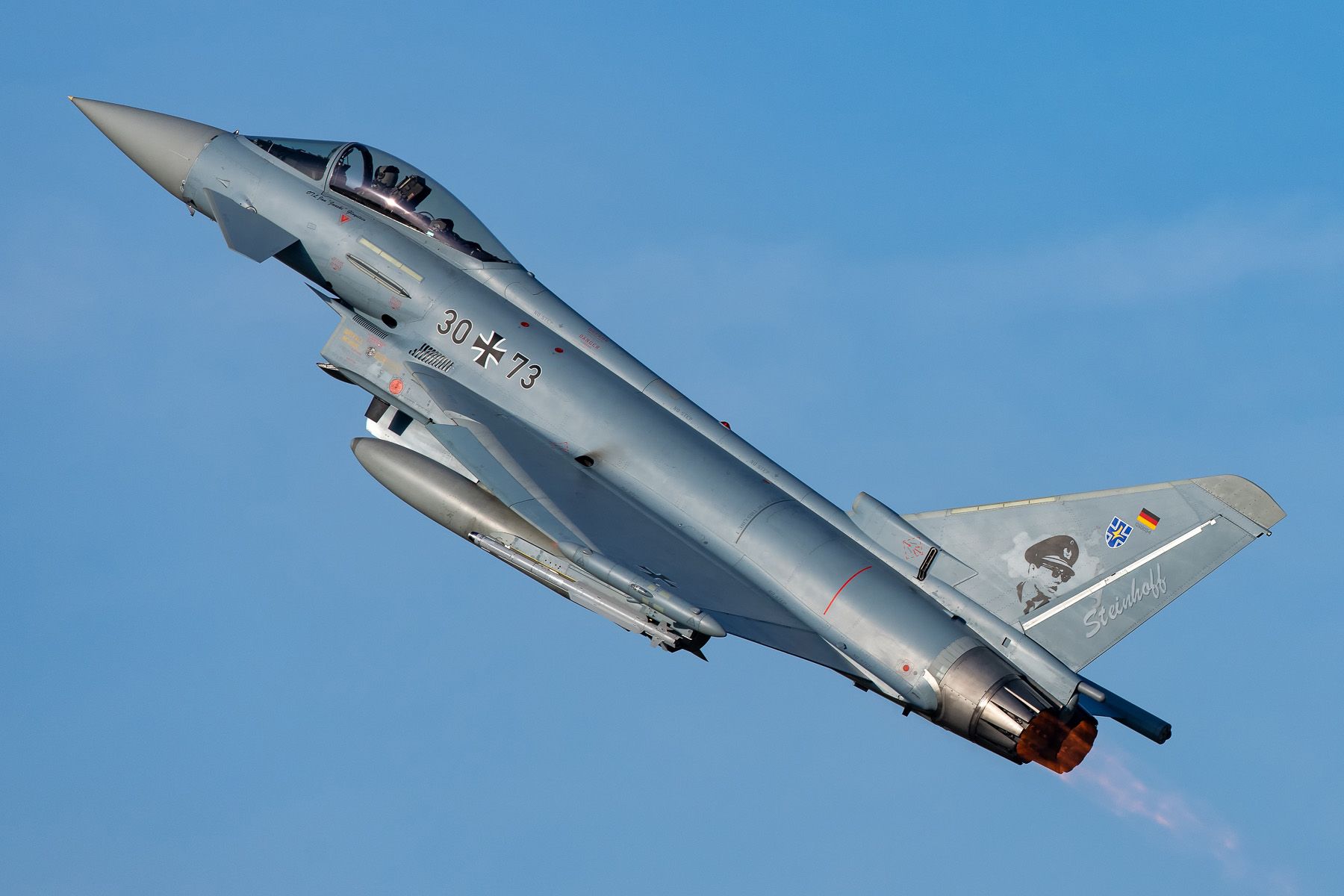
In the first half of 2006, four pilots of Jagdgeschwader 74 started their Eurofighter conversion course and on 25 July that same year, the first five new aircraft (GT0005/30+05, GS0003/30+08, GS0008/30+15, GS0011/30+19 and GS0012/30+21) touched down at Neuburg, Bavaria marking the start of the F-4F Phantom II replacement. JG 74 became the seventh operator of the type, following JG 73, Ala 11 (Spain), 4° Stormo (Italy) and 3(F), 17(R) and 29 Squadrons (UK).
Supplying JG 74 with new aircraft was initially delayed due to Luftwaffe Block 2B aircraft being redirected to Austria, while the R2 upgrade also kept various airframes out of service. From 1 January 2008, the 24hr Quick Reaction Alert (QRA) duty with Eurofighters was planned to be operational, but this had to be postponed because of that delay. To solve this, Phantoms from JG 71 temporarily relocated to Neuburg to maintain the QRA. Meanwhile, test scrambles were flown early 2008 in a two-week campaign. During this, live cannon firings were done to strafe Do SK 10 target banners towed by A-4 Skyhawks operated by Flight Systems Inc. On 3 June 2008, Eurofighters finally started their QRA duty in the form of Block 5 aircraft armed with IRIS-T.
On 16 March 2009, JG 74 logs the 10,000th Eurofighter flying hour in Luftwaffe service. Another milestone was the first Baltic Air Policing mission with German Eurofighters. During this deployment, the first Luftwaffe Eurofighter intercept was done when on or around 12 September 2009 a Russian An-72 flying in international airspace but close to Baltic airspace was intercepted and escorted. A few days later, a Russian A-50 was intercepted.
In May 2010, JG 74 dispatched two aircraft (GS0014/30+23 and GS0017/30+28) along with IPA3 to RAF Lossiemouth, UK for an AMRAAM campaign. On 15 March 2013, JG 74 commanding officer Col. Andreas Pfeiffer logged the wing’s 10.000th Eurofighter flying hour in GT0015/30+42 during his last flight.
With the disbandment of Jagdbombergeschwader 32 that operated Tornados from nearby Lechfeld, the tiger traditions of that wing’s 321 Staffel were transferred to Jagdgeschwader 74. Both Staffel 741 ‘Falcons’ and 742 ‘Zapatas’ now joined the NATO Tiger family on 18 March 2013.
JG 74 was redesignated to Taktisches Luftwaffengeschwader 74 on 1 October 2013, although its primary mission remains air defence. It is allocated to the NATO Response Force (NRF).
On 21 September 2014, two Eurofighters from TaktLwG 74 carried out an armed alpha scramble during a Baltic Air Policing deployment, intercepting two Russian fighter aircraft over the Baltic Sea.
On 16 April 2021, a milestone is reached when TaktLwG 74 got their hands on the first P2Eb-upgraded Eurofighter (GS0095/31+35), now allowing to use the Meteor air-to-air missile. One year later, the wing went down under during Rapid Pacific 2022 in a historic deployment, joining the Pitch Black 2022 exercise in Australia but also paying visits to Japan and South Korea.
Historical reference: Jagdgeschwader 74 was established on Neuburg on 1 May 1961, taking over the F-86K Sabres from sister unit JG 75 that came over from Leipheim and simultaneously disbanded. On 12 May 1964 the first F-104G Starfighter arrived, and the last Sabres left Neuburg in January 1966.
A decade later, the Starfighters made room for Phantoms. While the first four F-4F Phantom II arrived at Neuburg on 26 September 1974, the wing became operational with the new type in 1975.
From April 1992, JG 74 started to operate the improved variant, the F-4F ICE (Improved Combat Efficiency) or KWS (Kampfwertsteigerung).Then the Eurofighters came to the scene, and the last Phantoms were retired in a fly-out ceremony on 12 June 2008.
Exercises etc. with JG 74 / TaktLwG 74 involvement
- 10/25 June 2009 - four aircraft deployed to Decimomannu, Italy with 44 sorties flown
- 1 Sept/31 Oct 2009 - the first of many Baltic Air Policing deployments. Four aircraft operated out of Šiauliai, Lithuania
- 6/22 June 2012 - eight aircraft joined Red Flag Alaska 12-2 at Eielson AFB, Alaska USA
- 17/28 June 2013 - for the first tiger meet participation of JG 74/TaktLwG 74, three aircraft flew to Ørland, Norway to join the NTM 2013 Norway (all subsequent Tiger Meets are omitted in this list, but you can visit the NTM website for details)
- 1 Sept /31 Dec 2014 - four aircraft to Ämari, Estonia for Baltic Air Policing
- 25 May/2 June 2015 - twelve aircraft joined the Arctic Challenge Exercise 2015 (ACE 15) at Bodø, Norway
- 1 Sept/31 Dec 2016 - four aircraft to Ämari, Estonia for Baltic Air Policing
- 1 Sept/31 Dec 2018 - four aircraft to Ämari, Estonia for Baltic Air Policing
- 22 May/4 June 2019 - six aircraft joined the Arctic Challenge Exercise 2015 (ACE 15) at Bodø, Norway along with two aircraft each from TaktLwG 31 and 71
- 1 Sep 2020/30 Apr 2021 - joint Baltic Air Policing deployment to Ämari, Estonia by TaktLwG 74 (three aircraft) and TaktLwG 71 (two aircraft)
- 6/16 July 2021 - three aircraft deploy to Creech AFB, Nevada USA for Exercise Dynamic Duo 21
- Feb/Mar 2022 - three aircraft to Mihail Kogălniceanu, Romania for enhanced Air Policing South. Following the Russian invasion into Ukraine, three more aircraft were added
- 15 Aug/8 Oct 2022 - six aircraft fly down under in the Rapid Pacific 2022 deployment to join Exercise Pitch Black 2022 from 19 August to 8 September. Thereafter Japan and South Korea are visited before returning home
- 1 Mar/30 Nov 2024 - five aircraft to Lielvārde, Latvia for Baltic Air Policing
- 17/31 Oct 2025 - six aircraft join Exercise Ocean Sky 2025 at Gando-Las Palmas, Spain
- 13/20 Feb 2026 - four aircraft to Keflavik, Iceland for Arctic Sentry
- 9/27 Mar 2026 - eight aircraft to RAF Waddington, UK for Exercise Cobra Warrior 26-1
- 20 Jul/7 Aug 2026 - six aircraft participated in Exercise Pitch Black 2026, operating from RAAF Darwin, Australia
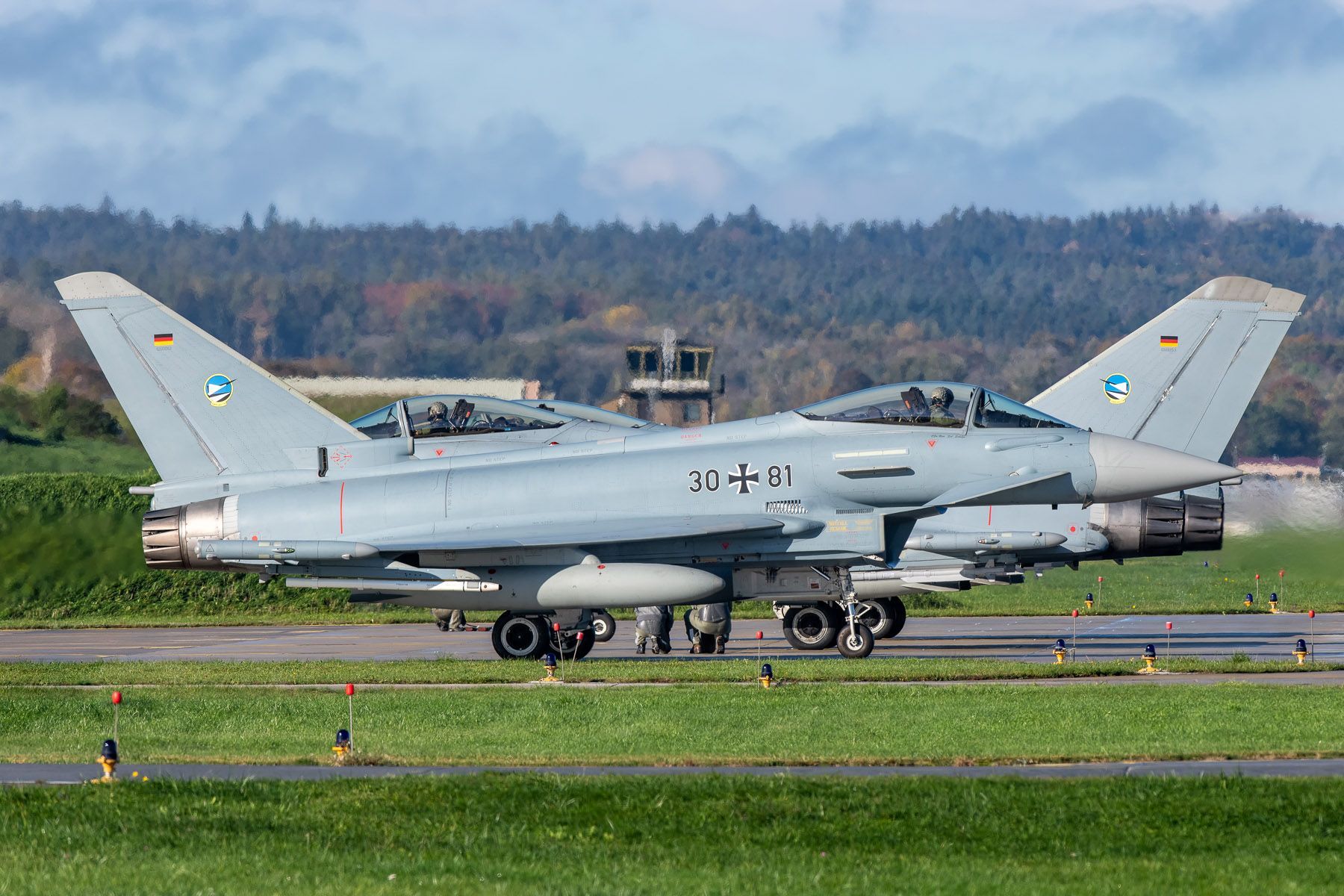
Wehrtechnische Dienststelle 61
WTD 61 is one of the Bundeswehr’s test and evaluation units, the Manching-based unit being focused on aviation. It is not a Luftwaffe unit, but directly controlled by the Bundesamt für Ausrüstung, Informationstechnik und Nutzung der Bundeswehr (BAAINBw – Federal Office of Equipment, Information Technology and Use of the German Armed Forces).
Some WTD 61 pilots have been heavily involved in all kinds of test programmes, in close cooperation with the industry. Having said that, both DA1 and DA5 have been operated solely by the multinational manufacturer. This also is the case for Germany’s three Instrumented Production Aircraft, IPA3 (98+03), IPA7 (98+07) and IPA8 (98+08). Nevertheless, IPA3 has indeed been handed over to WTD 61 on 15 August 2008, and is de facto the sole Eurofighter in the hands of WTD 61. It has not been active for awhile though, and IPA3 has probably retired from flying service by 2024.
Historical reference: this test unit was originally established as Erprobungsstelle 61 at Oberpfaffenhofen on 1 October 1957. It moved to Manching in 1967 and was redesignated Wehrtechnische Dienststelle in 1987. It contains several divisions involved in a wide range of aeronautical testing in support of the German armed forces.
Taktisches Luftwaffengeschwader 31 'Boelcke'
According to the original timeline, Jagdgeschwader 71 would be the next in line to trade their Phantoms for Eurofighters. But instead, it was decided to re-equip Jagdbombergeschwader 31 first. On 16 December 2009 the first Eurofighters arrived for a ceremony to celebrate the conversion.
As a ground attack unit, JaBoG 31 had a limited choice of weapons for their Eurofighters in the beginning. It took awhile before the GBU-48 was cleared for use. Nevertheless, the wing continued their operations with the new aircraft that now had replaced the Tornado IDS. JaBoG 31 would also carry out occasional QRA duties, and on 4 January 2012 the first Tango-scramble was conducted.
On 1 October 2013, Jagdbombergeschwader 31 became Taktisches Luftwaffengeschwader 31 and although it still focuses on air-to-ground, it now takes on the air defence role also. This can be recognised by the wing having joined several Baltic Air Policing and enhanced Air Policing deployments so far, and it can also temporarily take over the QRA role from TaktLwG 71 or 74 if the need arises.
TaktLwG 31 became the first Luftwaffe Eurofighter wing to be equipped with Rafael Litening III targeting pods. On 20 January 2016 the first operational mission with this laser designator system was done with GS0091/31+31. During September 2017, TaktLwG 31 deployed to Vidsel, Sweden for the first drop of a GBU-48 Paveway II. Deployed were GT0016/30+54, GS0095/31+35 and GS0099/31+39.
Since 2019, the TaktLwG 31 is allocated to the NATO Response Force (NRF).
Historical reference: established on 1 October 1957 at Büchel because its projected home-base Nörvenich was under construction, Jagdbombergeschwader 31 became operational on 20 June 1958 at the latter location. On 20 April 1961 the wing was named after WW I fighter pilot Oswald Boelcke.
The F-84F Thunderstreaks would soon be replaced and on 20 June 1962 JaBoG 31 became the first operational Luftwaffe F-104G Starfighter unit. When Panavia Tornado IDS fighter-bomber aircraft arrived here in 1983, the Geschwader was again the first West-German wing to become operational on that type. The last Tornados were withdrawn in 2010 following the introduction of Eurofighter the year before.
JaBoG 31 was redesignated to Taktisches Luftwaffengeschwader 31 on 1 October 2013. Between 1 July 2013 and 4 July 2016, the Wittmund-based Taktische Luftwaffengruppe ‘Richthofen’ was placed under the command of TaktLwG 31.
Exercises etc. with JaBoG 31 / TaktLwG 31 involvement
- 16/27 April 2012 - six aircraft to Exercise Frisian Flag 2012 at Leeuwarden, Netherlands
- July/August 2012 - several aircraft deployed to Decimomannu, Italy
- 18 Nov/13 Dec 2012 - six aircraft joined the Advanced Tactical Leadership Course at Al Dhafra, UAE
- 15/26 April 2013 - six aircraft to Exercise Frisian Flag 2013 at Leeuwarden, Netherlands
- 31 Mar/4 Apr 2014 - eight aircraft to Exercise Frisian Flag 2014 at Leeuwarden, Netherlands
- 13/24 April 2015 - eight aircraft (plus two from TaktLwGrp ‘Richthofen’) to Exercise Frisian Flag 2015 at Leeuwarden, Netherlands
- 1 Sept/31 Dec 2015 - four aircraft to Ämari, Estonia for Baltic Air Policing
- 11/22 Apr 2016 - eight aircraft (plus two from TaktLwG 74) to Exercise Frisian Flag 2016 at Leeuwarden, Netherlands
- 30 Aug/15 Sep 2016 - several aircraft deployed to Decimomannu, Italy. This was the last regular deployment to this base as the Luftwaffe terminated the contract to use the Air Weapons Training Installation, a cooperation that had started in 1960
- 27 Mar/ 7 Apr 2017 - ten aircraft to Exercise Frisian Flag 2017 at Leeuwarden, Netherlands
- 4/18 May 2018 - seven aircraft joined Exercise Green Flag West 18-07 at Nellis AFB, Nevada USA
- 1/12 Apr 2019 - eight aircraft (plus two from TaktLwG 74) to Exercise Frisian Flag 2019 at Leeuwarden, Netherlands
- 8/20 March 2020 - six aircraft (one loaned from TaktLwG 73 and two from TaktLwG 74) to Red Flag 20-2, Nellis AFB, Nevada USA
- Feb/Mar 2023 - three aircraft to Creech AFB, Nevada USA for Exercise Drove Bog 2023
- 29 May/2 June 2023 - nine aircraft (including two dispatched from Laage) joined Arctic Challenge Exercise 23 (ACE 23) at Rovaniemi, Finland
- 2/13 Oct 2023 - eight aircraft to Exercise Frisian Flag 2023 at Leeuwarden, Netherlands
- 22 Nov/20 Dec 2023 - four aircraft to Mihail Kogălniceanu, Romania for enhanced Air Policing South
- 1 Aug 2025/23 Mar 2026 - five aircraft to Minsk Mazowiecki, Poland for enhanced Air Policing North
- 14 Sep/1 Oct 2026 - eight aircraft joined Exercise Cobra Warrior 26-2 operating out of RAF Cranwell, UK
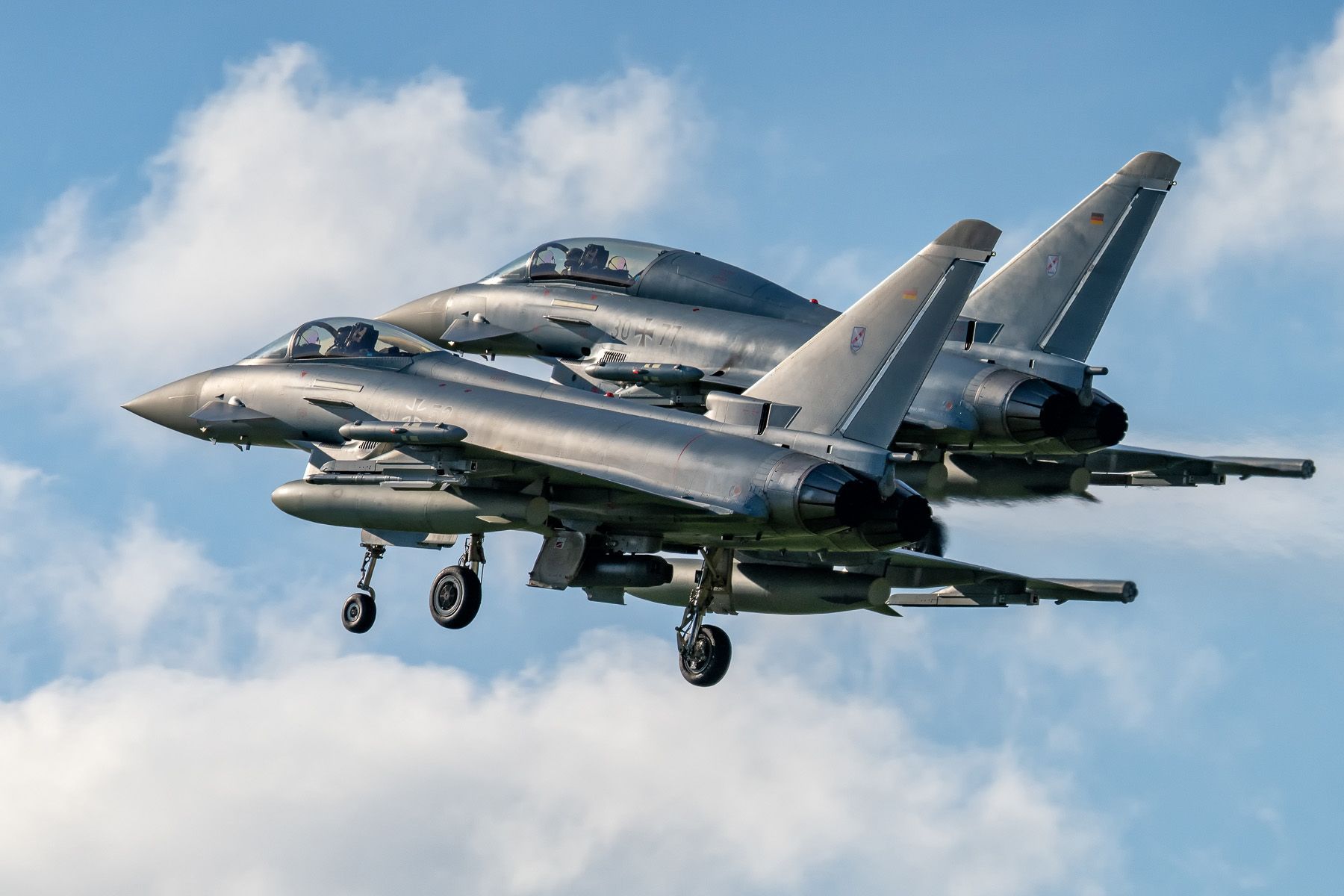
Taktisches Luftwaffengeschwader 71 'Richthofen'
After Jagdbombergeschwader 31 had transited to the new type, it was Jagdgeschwader 71’s turn to operate Eurofighters. This Wittmund-based unit was the last Luftwaffe unit to operate the F-4F ICE Phantom II. But there were some strings attached. It would not become a fully equipped wing, but instead a downsized unit was created. This was called Taktische Luftwaffengruppe ‘Richthofen’ and placed under command of JaBoG 31. Eurofighters of this group – operating out of Wittmund since 2013 – could be recognised by wearing badges of both units.
Then things changed again in December 2014. The decision to withdraw Tornado crew training from Holloman AFB, New Mexico apparently freed up sufficient resources to enable the TaktLwGrp ‘Richthofen’ to become a full Geschwader again. And while this was initially foreseen to happen not before 2018, an official announcement was made on 30 March 2015 that the Taktisches Luftwaffengeschwader 71 would now be activated on 1 July 2016.
The TaktLwG 71 maintains a 24/7 QRA as part of NATO’s air defence organisation. Due to extensive renovations required at its home base, the wing relocated to Laage from January 2022 till July 2025. As the constructions were not yet completed, the QRA remained active at Laage for another year, which of course is also more suitably located near the Baltic and NATO’s eastern border. Nevertheless, on 13 July 2026 the QRA also returned to Wittmund.
From 31 August to 6 September 2024, three aircraft joined Exercise Baana 24 hosted by the Finland’s Lapland Air Wing at Rovaniemi. This exercise involved operations from a prepared highway strip and was the first such occasion with Luftwaffe Eurofighters. Also hot refuelling was conducted. In the Cold War, West Germany had many highway strips but these are no longer maintained. The Luftwaffe is now getting this proficiency back again to prepare this kind of operation in view of NATO commitments.
Historical reference: formed on 6 June 1959 at Ahlhorn, Jagdgeschwader 71 was equipped with Canadair CL-13 Sabre Mk. 6 fighters. On 21 April 1961 it was given the honorary title ‘Richthofen’ named after the WW I ace Manfred Freiherr von Richthofen, aka the Red Baron. In 1963 it relocated to Wittmund where it would soon re-equip with the F-104G Starfighter. These iconic fighters would be superseded by the F-4F Phantom II in 1974. From the early 1990s, these would be upgraded to F-4F ICE (Improved Efficiency Upgrade) or KWS (Kampfwertsteigerung).Being the last Luftwaffe unit to operate Phantoms, these were retired during a large fly-out ceremony on 29 June 2013.
Exercises etc. with TaktLwGr 'R' / TaktLwG 71 involvement
- 13/24 April 2015 - two aircraft joined the TaktLwG 31 detachment to Exercise Frisian Flag 2015 at Leeuwarden, Netherlands
- 9 Apr/20 Apr 2018 - six aircraft (plus two from TaktLwG 31) to Exercise Frisian Flag 2018 at Leeuwarden, Netherlands
- 1 Jan/30 Apr 2019 - four aircraft to Ämari, Estonia for Baltic Air Policing
- 3/14 Nov 2019 - six aircraft (including three loaned from TaktLwG 73 joined Exercise Blue Flag at Ovda, Israel
- 1 Sept 2020/30 Apr 2021 - mixed deployment of TaktLwG 71 (two aircraft) and TaktLwG 74 (three aircraft) to Ämari, Estonia for Baltic Air Policing
- 1 Aug/1 Oct 2022 - four aircraft to Ämari, Estonia for Baltic Air Policing
- July / August 2024 - together with three aircraft from TaktLwG 73, five aircraft joined the large Pacific Skies 24 deployment around the globe. The TaktLwG 71 contingent participated in Exercise Arctic Defender (Eielson AFB, Alaska, 8/18 July), Exercise Pitch Black 24 (Tindal, Australia, 20 July/2 August) and Exercise Tarang Shakti Phase 1 (Sulur, India, 6/13Aug)
- 31 Aug/6 Sep 2024 - three aircraft joined exercise Baana 24, operating from a Finnish highway
- 31 Mar/10 Apr 2025 - eight aircraft to Leeuwarden, Netherlands for exercise Ramstein Flag 25
- 1 Aug 2025/1 Apr 2026 - five aircraft to Mihail Kogălniceanu, Romania for enhanced Air Policing South
- 8/19 Jun 2026 - eight aircraft operated from Rovaniemi, Finland for Exercise Ramstein Flag-North (RAFL 26)
- 24/28 Aug 2026 - four aircraft operated out of nearby Jever in Richthofen Shield 2026, an Agile Combat Employment (ACE) exercise
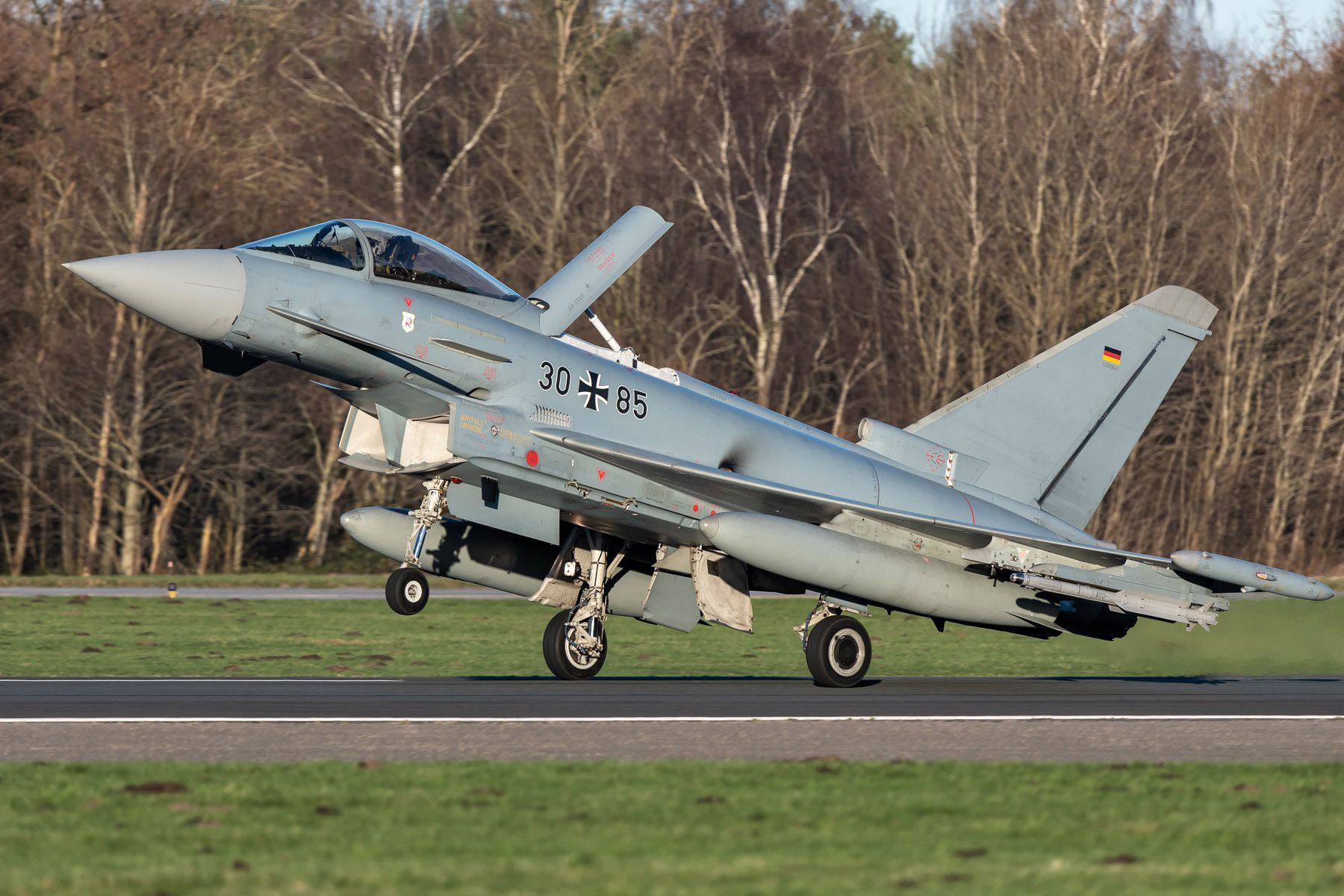
Taktisches Luftwaffengeschwader 33
Indeed, this wing did never operate Eurofighters. Originally planned to receive these from 2013, this was cancelled when Tranche 3 was split with Tranche 3B never being ordered. The Büchel-based unit continued to fly the Tornado IDS, and will now receive the Lockheed-Martin F-35A Lightning II. This also meant that Eurofighter would now not have to be certified for the tactical B61 weapon.
Waffenschule der Luftwaffe
The Waffenschule was established at Laage on 1 April 2018. It organises Weapon Instructor Courses for the Luftwaffe. Yet, the Waffenschule has no aircraft assigned and the courses are of course not exclusively for Eurofighter pilots. Still, I feel it is worthwhile to mention here.
Nationales Test- und Entwicklungszentrum Eurofighter
In 2021, Germany was not sure that the other Eurofighter partner nations would purchase extra Eurofighters. Nevertheless, it wanted to secure that the development of the aircraft would be continued. To mitigate this, plans were developed to establish a test centre exclusively for Germany. A pilot phase to establish the Nationales Test- und Entwicklungszentrum Eurofighter (NaTE EF) was finished by mid 2021, and this new unit was dedicated to operate the Instrumented Production Aircraft (IPA10) as well as the three Instrumented Series Production Aircraft (ISPA) to be delivered as part of Tranche 4. The further use of the ECRS Mk1 radar by supporting Airbus and Hensoldt in view of hardware and software development will be one of the key points.
NaTE EF was established at Manching on 8 April 2025 and in absence of the expected Tranche 4 aircraft, the unit received two dual-seat aircraft from TaktLwG 74 - GT0025/31+13 and GT0028/31+25 - later followed by GS0053/30+72 from the same wing. The first Tranche 4 aircraft will not join before late 2027.
Apart from the radar, NaTE EF focused on another project first. Early 2025, Airbus prepared a Eurofighter testbed for MUM-T (manned-unmanned taming testbed) technologies. This System and Teaming Advanced Research (STAR) demonstrator is one of NaTE EF’s dual-seat aircraft. It features a decoupled rear cockpit and is capable of controlling uncrewed aircraft systems (UAS) using data links and communications systems fitted into a pod. Parts were taken from Eurofighter’s Long-Term Evolution (LTE) programme to offset them into an external pod to ease certification and integration. The mentioned UAS might involve the ‘Wingman’, an unmanned fighter-type drone.
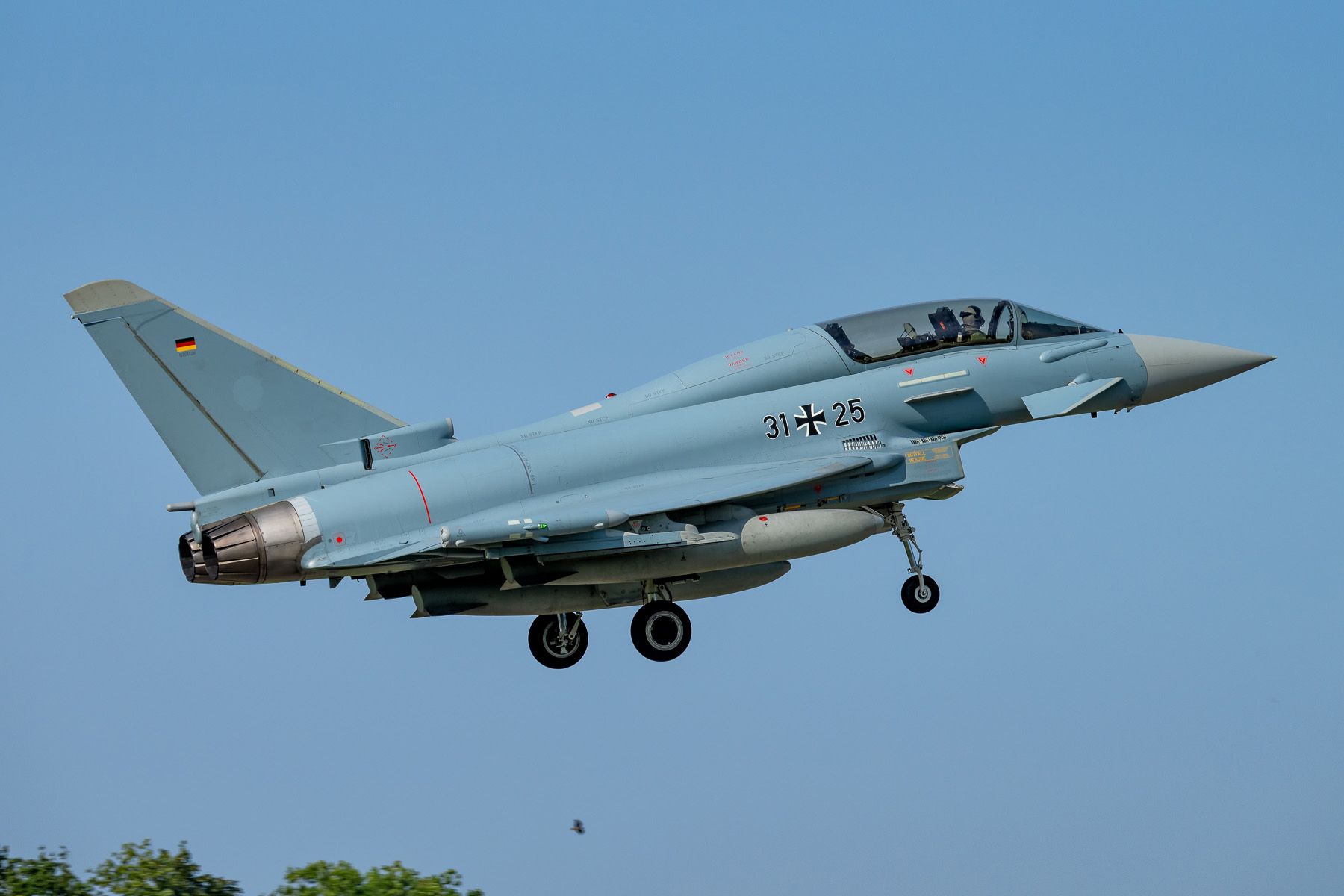
Taktisches Luftwaffengeschwader 51 'Immelmann'
The final unit to receive Eurofighters will be TaktLwG 51 ‘Immelmann’ based at Schleswig-Jagel. It is currently operating Tornado ECRs in the electronic combat role, and also serves as operational conversion unit with a number of twin-stick Tornado IDS(T) aircraft. For the surveillance role, TaktLwG 51 is furthermore equipped with German Heron TP drones while a trio of Global 6500 aircraft is currently fitted with a special suite before these will join the unit as well.
Some 35 Eurofighter Elektronische Kampf (EF EK) will replace the Tornado ECRs in their specialised role. The EF EKs cover Tranche 5 as well as 15 aircraft from Tranche 4. The first ones are expected to join TaktLwG 51 around 2030. ■